Фрезерный инструмент Sandvik 2026 - страница 10
Навигация
 Каталог Sandvik токарные инструменты 2017
 Каталог Sandvik цельный режущий инструмент 2018
 Дополнение к каталогам Sandvik 2020.2
 Инструмент для отрезки и обработки канавок Sandvik 2026
 Каталог Sandvik инструменты для автоматов продольного точения 2018
 Каталог Sandvik базовые наборы инструментов для новых станков
 - Selection guide
- Shoulder milling tools
- CoroMill® MS20
- CoroMill® MS20, cutter for square shoulder milling
- CoroMill® MS20, Silent Tools™ cutter for square shoulder milling
- CoroMill® MS20, cutter for square shoulder milling
- CoroMill® MS20, insert for milling
- CoroMill® MS40
- CoroMill® MS40, tangential square shoulder milling cutter
- CoroMill® MS40, insert for milling
- CoroMill® MS60
- CoroMill® MS60, square shoulder milling cutter
- CoroMill® MS60, insert for milling
- CoroMill® 390
- CoroMill® 390, cutter for square shoulder milling
- CoroMill® 390, long edge cutter for square shoulder milling
- CoroMill® 390, Silent Tools™ cutter for square shoulder milling
- CoroMill® 390, insert for milling
- CoroMill® 390, insert for square shoulder milling
- CoroMill® 390, insert for milling
- CoroMill® 490
- CoroMill® 490, cutter for square shoulder milling
- CoroMill® 490, insert for milling
- Face milling tools
- CoroMill® MF80
- CoroMill® MF80, face milling cutter
- CoroMill® MF80, insert for milling
- CoroMill® 245
- CoroMill® 245, cutter for face milling
- CoroMill® 245, insert for milling
- CoroMill® 345
- CoroMill® 345, cutter for face milling
- CoroMill® 345, insert for milling
- CoroMill® 745
- CoroMill® 745, cutter for face milling
- CoroMill® 745, insert for milling
- CoroMill® 365
- CoroMill® 365, cutter for face milling
- CoroMill® 365, insert for milling
- CoroMill® Century
- CoroMill® Century, cutter for face milling
- CoroMill® Century, insert for milling
- High feed milling tools
- CoroMill® MH20
- CoroMill® MH20, cutter for high feed milling
- CoroMill® MH20, insert for milling
- CoroMill® 210
- CoroMill® 210, cutter for high feed milling
- CoroMill® 210, insert for milling
- CoroMill® 419
- CoroMill® 419, cutter for high feed milling
- CoroMill® 419, insert for milling
- Profile milling tools
- CoroMill® MR80
- CoroMill® MR80, face milling cutter
- CoroMill® MR80, insert for milling
- CoroMill® 300
- CoroMill® 300, cutter for profile milling
- CoroMill® 300, insert for milling
- CoroMill® 200
- CoroMill® 200, cutter for profile milling
- CoroMill® 200, insert for milling
- CoroMill® 216
- CoroMill® 216, cutter for profile milling
- CoroMill® 216, insert for profile milling
- Groove milling tools
- CoroMill® 331
- CoroMill® 331, adjustable disc cutter for full side and face milling
- CoroMill® 331, adjustable cutter for full side and face milling
- CoroMill® 331, cutter for full side and face milling
- CoroMill® 331, adjustable cutter for half side and face milling
- CoroMill® 331 adjustable half side and face disc milling cutter
- CoroMill® 331, adjustable cutter for half side and back face milling
- CoroMill® 331, adjustable double half side and face disc milling cutter
- CoroMill® 331, insert for side and face milling
- CoroMill® QD
- CoroMill® QD, cutter for grooving and parting off
- CoroMill® QD, insert for grooving
- CoroMill® 327
- Adaptor with cylindrical shank coupling to CoroMill® 327
- Adaptor with Weldon coupling to CoroMill® 327
- Adaptor with Coromant® EH coupling to CoroMill® 327
- Adaptor with ER coupling to CoroMill® 327
- CoroMill® 327, solid carbide head for grooving
- CoroMill® 327, solid carbide head for thread milling
- CoroMill® 327, solid carbide head for chamfering
- CoroMill® 328
- CoroMill® 328, groove milling cutter
- CoroMill® 328, insert for groove milling
- CoroMill® 328, insert for thread milling
- General information
- Coolant supply information
- Cutting tool parameters according to ISO 13399
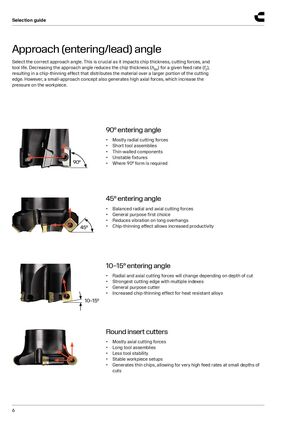
Угол входа (подъезда)
Выберите правильный угол входа. Это имеет решающее значение, так как влияет на толщину стружки, силы резания и срок службы инструмента. Уменьшение угла входа снижает толщину стружки (hex) для заданной подачи (fz), создавая эффект истончения стружки, который распределяет материал по большей части режущей кромки. Однако концепция с малым углом входа также создаёт высокие осевые силы, которые увеличивают нагрузку на заготовку.
Угол входа 90°
- Преимущественно радиальные силы резания
- Короткие сборки инструмента
- Тонкостенные детали
- Неустойчивые приспособления
- Там, где требуется форма под 90°
Угол входа 45°
- Сбалансированные радиальные и осевые силы резания
- Универсальный выбор первой очереди
- Снижает вибрацию на длинных выпусках
- Эффект истончения стружки позволяет повысить производительность
Угол входа 10–15°
- Радиальные и осевые силы резания будут изменяться в зависимости от глубины резания
- Самая прочная режущая кромка при множественных переиндексировках
- Универсальная фреза
- Повышенный эффект истончения стружки для жаропрочных сплавов
Фрезы с круглыми пластинами
- Преимущественно осевые силы резания
- Длинные сборки инструмента
- Меньшая жёсткость инструмента
- Устойчивые установки заготовки
- Создают тонкую стружку, позволяя очень высокие подачи при неглубоких резах