Оптимальный выбор Kennametal 2025 - 2026 - страница 233
Навигация
 Каталог Kennametal инновации 2019.1
 Инновационные токарные пластины с покрытиями KENGold CVD и PVD Kennametal 2025
 Новинки Kennametal - осень 2025
 Новинки Kennametal - осень 2024
 Каталог Kennametal инструментальные системы 2018
 Сверла со сменными пластинами линейки Drill Fix PRO Kennametal 2024
- Main TOC
- Turning TOC
- KCP25C - KENGOLD CVD
- KCU10B - KENGOLD PVD
- KCU25B - KENGOLD PVD
- KBH10B & KBH20B
- Quick & Easy Insert Selection
- Spare Parts & Accessories Information
- Negative Insert Toolholders
- Positive Insert Toolholders
- Boring Bars - Negative Inserts
- Boring Bars - Postivie Inserts
- ISO/ANSI Insert Grade Descriptions
- Beyond Evolution - Grooving, Turning & Cut-Off
- Application Data - Recommended Starting Speeds
- Application Data - Plunge Feed Rates
- Application Data - Turn & Profile Feed Rates
- A4 Tooling & Double-Sided Inserts
- Application Data - Recommended Starting Speeds
- Application Data - Plunge Feed Rates
- Application Data - Turn & Profile Feed Rates
- Laydown Triangle Threading
- Application Data - Recommended Starting Speeds
- Turning Toolholder & Boring Bar Torque Recommendation
- Indexable Milling TOC
- Dodeka Series
- Recommended Starting Feeds
- Recommended Starting Speeds - Dry Machining
- Receommended Starting Speeds - Wet Machining
- 7745VOD Series
- Recommended Starting Feeds
- Recommended Starting Speeds - Dry Machining
- Recommended Starting Speeds - Wet Machining
- Mill 4-11
- Recommended Starting Feeds
- Recommended Starting Speeds - Dry Machining
- Recommended Starting Speeds - Wet Machining
- Mill 4-15
- Recommended Starting Feeds
- Recommended Starting Speeds - Dry Machining
- Recommended Starting Speeds - Wet Machining
- Mill 1-10
- Recommended Starting Feeds
- Recommended Starting Speeds - Dry Machining
- Recommended Starting Speeds - Wet Machining
- Application Examples
- Mill 1-14
- Application Examples
- Recommended Starting Feeds
- Recommended Starting Speeds - Dry Machining
- Recommended Starting Speeds - Wet Machining
- Mill 4-12KT
- Recommended Starting Feeds
- 7792 High-Feed Series
- Recommended Starting Feeds
- Recommended Starting Speeds - Dry Machining
- Recommended Starting Speeds - Wet Machining
- 7713VR Series
- Recommended Starting Feeds
- Recommended Starting Speeds - Dry Machining
- Recommended Starting Speeds - Wet Machining
- 7713VR Technical Information
- Solid End Milling TOC
- HARVI I TE
- Application Data
- Application Recommendations
- HARVI Series
- Application Data
- Application Recommendations
- KOR 5DS
- Application Data
- KenCut RR
- Application Data
- MaxiMet & KenCut Aluminum
- Application Data
- GOmill PRO
- Application Data
- GOmill
- Application Data
- GOmill GP
- Application Data
- Duo-Lock
- Application Data
- Holemaking TOC
- GOdrill
- Application Data
- KENNA UNIVERSAL
- Application Data
- KenTIP FS
- HPG Application Data
- GTP Application Data
- KSEM
- Application Data
- KSEM PLUS
- Application Data
- Drill Fix PRO
- Application Data
- Feed Force Requirement
- Power Recommendation
- Torque Recommendation
- Drill Fix DFR Inserts
- Application Data
- Drill Fix DFSP Inserts
- Application Data
- Drill Fix DFT Inserts
- Application Data
- Tooling Systems TOC
- Hydraulic Chucks
- Shrink Fit Toolholders
- ER Collet Chucks
- Shell Mill Adapters
- End Mill Adapters
- Screw-On Adapters
- Chip Fan
- Material Cross Reference Guide
- Metal Cutting Safety
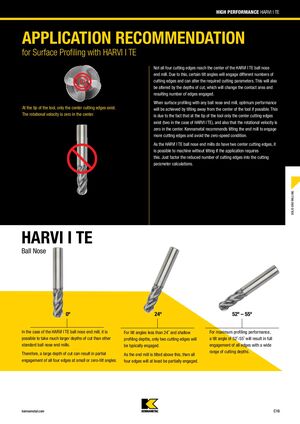
Рекомендации по применению профилирования поверхности с помощью HARVI I TE
Не все четыре режущих кромки фрезы HARVI I TE достигают центра инструмента. Из-за этого при определенных углах наклона различное количество режущих кромок будет входить в контакт и может изменять необходимые параметры резания. Это также зависит от глубин резания, которые изменяют площадь контакта и количество активных кромок.
При профилировании поверхности любой фрезой со сферическим концом оптимальная производительность достигается путем наклона в сторону от центра инструмента, если это возможно. Это связано с тем, что на вершине инструмента существуют только центральные режущие кромки (в случае HARVI I TE их две), а также с тем, что угловая скорость в центре равна нулю. Компания Kennametal рекомендует наклонять фрезу для включения большего количества режущих кромок и избежания нулевого условия скорости.
Поскольку фрезы со сферическим концом HARVI I TE имеют две центральные режущие кромки, возможно выполнение обработки без наклона, если это требуется для конкретного применения. Просто учитывайте сокращенное количество режущих кромок при расчете параметров резания.
HARVI I TE со сферическим концом
0°
При использовании фрезы со сферическим концом HARVI I TE возможно выполнение обработки с гораздо большей глубиной резания по сравнению с другими стандартными фрезами со сферическим концом. Поэтому большая глубина резания может привести к частичному включению всех четырех кромок при небольших углах наклона или нулевом наклоне.
24°
При углах наклона менее 24° и малых глубинах профилирования, как правило, задействуются только две режущие кромки. По мере увеличения угла наклона фрезы все четыре кромки будут хотя бы частично включены в работу.
52°–55°
Для максимальной производительности профилирования угол наклона 52°–55° обеспечивает полное включение всех кромок при широком диапазоне глубин резания.