Техническая информация Sumitomo - страница 2
Навигация
 Каталог Sumitomo пластины с алмазными вставками Sumidia
 Общий каталог Sumitomo 2019 - 2020
 Каталог Sumitomo токарные резцы (державки) для наружного точения
 Каталог Sumitomo твердосплавные пластины
 Каталог Sumitomo фрезы со сменными пластинами
 Каталог Sumitomo пластины с режущей кромкой-моноалмаз Sumicristal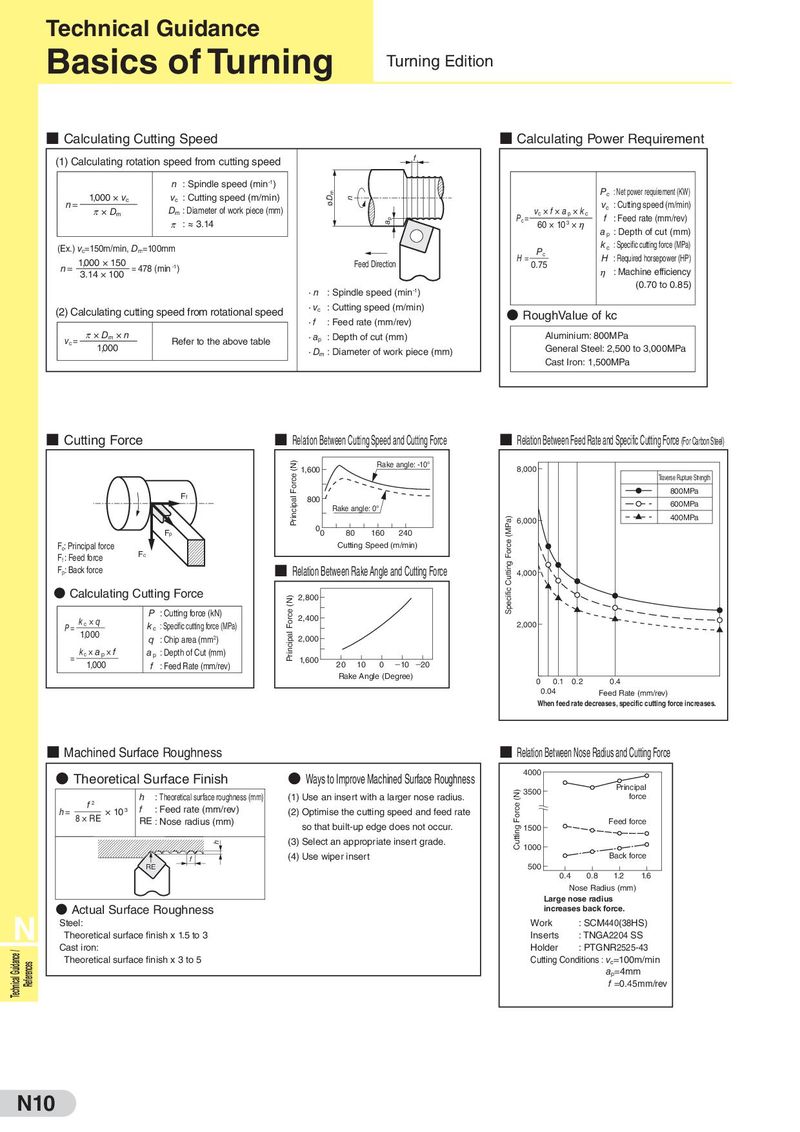
Basics of Turning
- Calculating Cutting Speed
- Calculating Power Requirement
(1) Calculating rotation speed from cutting speed f n : Spindle speed (min-1) P : Net power requirement (KW)
1,000 × v v : Cutting speed (m/min) c
n = c c
| π | v | : Cutting speed (m/min) | ||
| D × D : Diameter of work piece (mm) | v × f × a × k | c | ||
| m m | P = | c | p c | f : Feed rate (mm/rev) |
| π : ≈ 3.14 | c | 60 × 10 | η | |
| 3 × | ||||
| a | : Depth of cut (mm) | |||
| p | ||||
| (Ex.) v =150m/min, D =100mm | k | : Specific cutting force (MPa) | ||
| c | ||||
| m c | P | |||
| H = | c | H | : Required horsepower (HP) |
1,000 × 150 Feed Direction 0.75
n = = 478 (min -1) η : Machine efficiency
3.14 × 100 (0.70 to 0.85)
- n : Spindle speed (min-1)
(2) Calculating cutting speed from rotational speed v : Cutting speed (m/min)
c RoughValue of kc
- f : Feed rate (mm/rev)
π × D × n Aluminium: 800MPa
| v = | m | · a : Depth of cut (mm) | |
| Refer to the above table | p |
c 1,000 General Steel: 2,500 to 3,000MPa
- D : Diameter of work piece (mm) m
Cast Iron: 1,500MPa
- Cutting Force
- Relation Between Cutting Speed and Cutting Force
Rake angle: -10° 1,600
Ff 800 Rake angle: 0° 0
F p 0 80 160 240
F : Principal force Cutting Speed (m/min) c F : Feed force F c f
F : Back force Relation Between Rake Angle and Cutting Force p
- Calculating Cutting Force
2,800 P : Cutting force (kN)
k × q 2,400
| P = | c | k | : Specific cutting force (MPa) |
| c | |||
| 1,000 | |||
| q | 2,000 : Chip area (mm2) | ||
| k × a × f | a | : Depth of Cut (mm) | |
| = | c | p | p |
1,600 − −
1,000 f : Feed Rate (mm/rev) 20 10 0 10 20
Rake Angle (Degree)
- Machined Surface Roughness
- Theoretical Surface Finish
- Ways to Improve Machined Surface Roughness
h : Theoretical surface roughness (mm) (1) Use an insert with a larger nose radius. f 2
h = × 10 3 f : Feed rate (mm/rev) (2) Optimise the cutting speed and feed rate
8 × RE RE : Nose radius (mm) so that built-up edge does not occur. (3) Select an appropriate insert grade. (4) Use wiper insert
f RE
N Actual Surface Roughness
Steel: Theoretical surface finish x 1.5 to 3 Cast iron: Theoretical surface finish x 3 to 5
- Relation Between Feed Rate and Specific Cutting Force
(For Carbon Steel)
8,000 Traverse Rupture Strength 800MPa 600MPa 400MPa 6,000
4,000
2,000
0 0.1 0.2 0.4
0.04 Feed Rate (mm/rev) When feed rate decreases, specific cutting force increases.
- Relation Between Nose Radius and Cutting Force 4000
Principal 3500 force Feed force 1500 1000 Back force 500
0.4 0.8 1.2 1.6
Nose Radius (mm) Large nose radius increases back force. Work : SCM440(38HS)
Inserts : TNGA2204 SS Holder : PTGNR2525-43 Cutting Conditions : v =100m/min c a =4mm p f =0.45mm/rev