Техническая информация Sumitomo - страница 11
Навигация
 Каталог Sumitomo пластины с алмазными вставками Sumidia
 Общий каталог Sumitomo 2019 - 2020
 Каталог Sumitomo токарные резцы (державки) для наружного точения
 Каталог Sumitomo твердосплавные пластины
 Каталог Sumitomo фрезы со сменными пластинами
 Каталог Sumitomo пластины с режущей кромкой-моноалмаз Sumicristal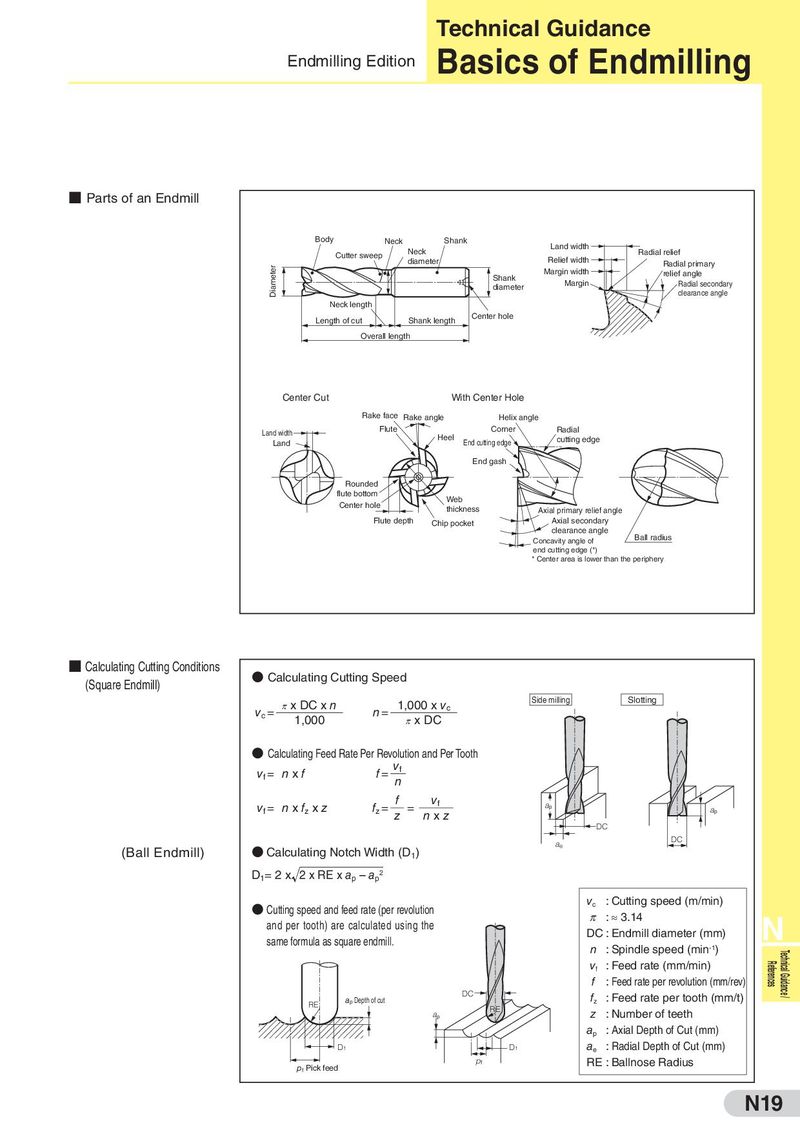
Basics of Endmilling
- Parts of an Endmill
| Body | Neck | Shank | ||||
| Land width | ||||||
| Neck | Radial relief | |||||
| Cutter sweep |
| diameter | Relief width | Radial primary | |
| Margin width | relief angle | ||
| Shank |
diameter Margin Radial secondary
clearance angle Neck length Center hole Length of cut Shank length
Overall length
Center Cut With Center Hole Rake face Rake angle Helix angle
| Flute | Corner | Radial | ||
| Land width | Heel |
Land End cutting edge cutting edge
End gash Rounded flute bottom Web
Center hole thickness Axial primary relief angle
Flute depth Chip pocket Axial secondary
clearance angle Ball radius Concavity angle of end cutting edge (*)
* Center area is lower than the periphery
- Calculating Cutting Conditions (Square Endmill)
(Ball Endmill)
- Calculating Cutting Speed
πxDCxn 1,000 x v Side milling Slotting
v = n = c
c 1,000 π x DC
- Calculating Feed Rate Per Revolution and Per Tooth
v
| v = | n x f | f = | f | ||||
| f | n | ||||||
| f | v | ||||||
| v = | n x f x z | f = | = | f | a | ||
| f | z z | p | a | ||||
| z | n x z | p |
DC DC
- ae
Calculating Notch Width (D )
1
| D = 2 x | 2 x RE x a – a | 2 | |
| 1 | p | p |
- v : Cutting speed (m/min)
Cutting speed and feed rate (per revolution c
π : ≈ 3.14 N
and per tooth) are calculated using the
DC : Endmill diameter (mm)
same formula as square endmill.
n : Spindle speed (min-1)
v : Feed rate (mm/min)
f
f : Feed rate per revolution (mm/rev)
DC f : Feed rate per tooth (mm/t) a Depth of cut z RE p RE z : Number of teeth a p
a : Axial Depth of Cut (mm)
p
| D | D | a : Radial Depth of Cut (mm) |
| 1 | 1 | e |
pf RE : Ballnose Radius p f Pick feed