Общий каталог Widia 2017 - страница 408
Навигация
 Каталог Widia токарный инструмент 2017
 Каталог Widia трохоидальное фрезерование
 Каталог Widia техническое руководство по разверткам
 Каталог Widia фрезы со сменными пластинами 2016
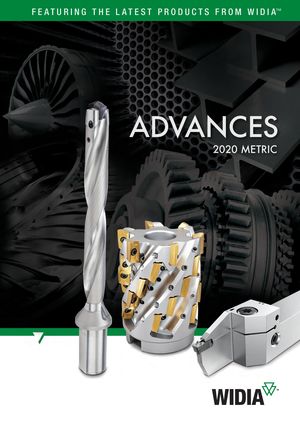 Каталог Widia достижения 2020
- Table of Contents
- Turning
- Turning • ISO Inserts
- Turning • Tools for External Turning and Internal Boring
- Turning • Tools for External Turning and Internal Boring
- Turning • Tools for Small Hole Boring
- com E1Turning • Grooving and Cut-Off
- Turning • Threading
- Indexable Milling
- Indexable Milling • Face Mills
- Indexable Milling • Chamfer Mills
- Indexable Milling • 90° Shoulder Mills
- Indexable Milling • Helical Mills
- Indexable Milling • Slotting Mills
- Indexable Milling • Copy Mills
- Solid End Milling
- Solid End Milling • High-Performance Solid Carbide End Mills
- Solid End Milling • General Purpose Solid Carbide End Mills
- Solid End Milling • High-Performance High-Speed Steel (HSS-E/PM)
- Solid End Milling • Burs
- Holemaking
- Holemaking • High-Performance Solid Carbide Drills
- Holemaking • Modular Drills
- Holemaking • Indexable Drills
- Holemaking • Modular Drills
- Holemaking • Indexable Drills
- Holemaking • Hole Finishing
- Tapping
- Tapping Portfolio
- Index by Order Number
- Index by Catalogue Number
- Global Contacts
- Informational Icons Guide
- Material Overview • DIN
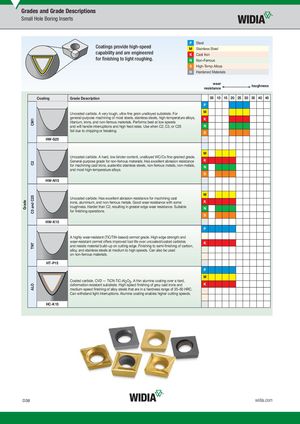
Small Hole Boring Inserts
| P | Steel | |
| Coatings provide high-speed | ||
| M | Stainless Steel | |
| capability and are engineered | ||
| K | Cast Iron | |
| for fi nishing to light roughing. | ||
| N | Non-Ferrous | |
| S | High-Temp Alloys | |
| H | Hardened Materials |
wear toughness resistance
Coating Grade Description 05 10 15 20 25 30 35 40 45
P M Uncoated carbide. A very tough, ultra-fi ne grain unalloyed substrate. For general-purpose machining of most steels, stainless steels, high-temperature alloys, K
titanium, irons, and non-ferrous materials. Performs best at low speeds and will handle interruptions and high feed rates. Use when C2, C3, or C25 N fail due to chipping or breaking. S HW-S25
Uncoated carbide. A hard, low binder content, unalloyed WC/Co fi ne-grained grade. General-purpose grade for non-ferrous materials. Has excellent abrasion resistance for machining cast irons, austenitic stainless steels, non-ferrous metals, non-metals, and most high-temperature alloys.
HW-N15
M K N S
HW-K15
HT-P15
HC-K15
Uncoated carbide. Has excellent abrasion resistance for machining cast irons, aluminium, and non-ferrous metals. Good wear resistance with some toughness. Harder than C2, resulting in greater edge wear resistance. Suitable for fi nishing operations.
A highly wear-resistant (TiC/TiN-based) cermet grade. High edge strength and wear-resistant cermet offers improved tool life over uncoated/coated carbides and resists material build-up on cutting edge. Finishing to semi-fi nishing of carbon, alloy, and stainless steels at medium to high speeds. Can also be used on non-ferrous materials.
Coated carbide. CVD — TiCN-TiC-Al2O3. A thin alumina coating over a hard, deformation-resistant substrate. High-speed fi nishing of grey cast irons and medium-speed fi nishing of alloy steels that are in a hardness range of 35–50 HRC. Can withstand light interruptions. Alumina coating enables higher cutting speeds.
M K N S
P
K
P M K