Общий каталог Widia 2017 - страница 697
Навигация
 Каталог Widia токарный инструмент 2017
 Каталог Widia трохоидальное фрезерование
 Каталог Widia техническое руководство по разверткам
 Каталог Widia фрезы со сменными пластинами 2016
 Каталог Widia достижения 2020
- Table of Contents
- Turning
- Turning • ISO Inserts
- Turning • Tools for External Turning and Internal Boring
- Turning • Tools for External Turning and Internal Boring
- Turning • Tools for Small Hole Boring
- com E1Turning • Grooving and Cut-Off
- Turning • Threading
- Indexable Milling
- Indexable Milling • Face Mills
- Indexable Milling • Chamfer Mills
- Indexable Milling • 90° Shoulder Mills
- Indexable Milling • Helical Mills
- Indexable Milling • Slotting Mills
- Indexable Milling • Copy Mills
- Solid End Milling
- Solid End Milling • High-Performance Solid Carbide End Mills
- Solid End Milling • General Purpose Solid Carbide End Mills
- Solid End Milling • High-Performance High-Speed Steel (HSS-E/PM)
- Solid End Milling • Burs
- Holemaking
- Holemaking • High-Performance Solid Carbide Drills
- Holemaking • Modular Drills
- Holemaking • Indexable Drills
- Holemaking • Modular Drills
- Holemaking • Indexable Drills
- Holemaking • Hole Finishing
- Tapping
- Tapping Portfolio
- Index by Order Number
- Index by Catalogue Number
- Global Contacts
- Informational Icons Guide
- Material Overview • DIN
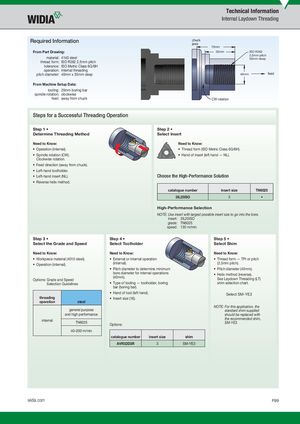
Internal Laydown Threading
Required Information chuck jaws 70mm
From Part Drawing: 35mm ISO R262 2,5mm pitch material: 4140 steel 50mm deep thread form: ISO R262 2,5mm pitch tolerance: ISO Metric Class 6G/6H operation: internal threading
pitch diameter: 40mm x 35mm deep 40mm feed
From Machine Setup Data: tooling: 20mm boring bar spindle rotation: clockwise feed: away from chuck CW rotation
Steps for a Successful Threading Operation
Step 1 Step 2 Determine Threading Method Select Insert
Need to Know: Need to Know:
- Operation (internal).
- Thread form (ISO Metric Class 6G/6H).
- Spindle rotation (CW).
- Hand of insert (left hand — NL).
Clockwise rotation.
- Feed direction (away from chuck).
- Left-hand toolholder.
- Left-hand insert (NL). Choose the High-Performance Solution
- Reverse helix method.
catalogue number insert size TN6025
3IL25ISO 3
High-Performance Selection NOTE: Use insert with largest possible insert size to go into the bore. insert: 3IL25ISO grade: TN6025 speed: 130 m/min
| Step 3 • | Step 4 • | Step 5 • |
| Select the Grade and Speed | Select Toolholder | Select Shim |
| Need to Know: | Need to Know: | Need to Know: |
- Workpiece material (4010 steel).
- External or internal operation
- Thread form — TPI or pitch
(internal). (2,5mm pitch).
- Operation (internal).
- Pitch diameter to determine minimum
- Pitch diameter (40mm).
| bore diameter for internal operations | • Helix method (reverse). | ||
| (40mm). | |||
| Options: Grade and Speed | See Laydown Threading (LT) | ||
| Selection Guidelines | • Type of tooling — toolholder, boring | shim selection chart. |
bar (boring bar).
- Hand of tool (left hand). Select SM-YE3
threading Insert size (16). operation steel NOTE: For this application, the general purpose standard shim supplied and high performance should be replaced with the recommended shim, internal TN6025 SM-YE3. Options: 40–200 m/min
catalogue number insert size shim
AVR32D3R 3 SM-YE3