Общий каталог Widia 2017 - страница 1514
Навигация
 Каталог Widia токарный инструмент 2017
 Каталог Widia трохоидальное фрезерование
 Каталог Widia техническое руководство по разверткам
 Каталог Widia фрезы со сменными пластинами 2016
 Каталог Widia достижения 2020
- Table of Contents
- Turning
- Turning • ISO Inserts
- Turning • Tools for External Turning and Internal Boring
- Turning • Tools for External Turning and Internal Boring
- Turning • Tools for Small Hole Boring
- com E1Turning • Grooving and Cut-Off
- Turning • Threading
- Indexable Milling
- Indexable Milling • Face Mills
- Indexable Milling • Chamfer Mills
- Indexable Milling • 90° Shoulder Mills
- Indexable Milling • Helical Mills
- Indexable Milling • Slotting Mills
- Indexable Milling • Copy Mills
- Solid End Milling
- Solid End Milling • High-Performance Solid Carbide End Mills
- Solid End Milling • General Purpose Solid Carbide End Mills
- Solid End Milling • High-Performance High-Speed Steel (HSS-E/PM)
- Solid End Milling • Burs
- Holemaking
- Holemaking • High-Performance Solid Carbide Drills
- Holemaking • Modular Drills
- Holemaking • Indexable Drills
- Holemaking • Modular Drills
- Holemaking • Indexable Drills
- Holemaking • Hole Finishing
- Tapping
- Tapping Portfolio
- Index by Order Number
- Index by Catalogue Number
- Global Contacts
- Informational Icons Guide
- Material Overview • DIN
Coolant
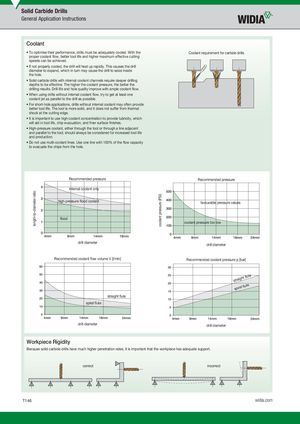
- To optimise their performance, drills must be adequately cooled. With the Coolant requirement for carbide drills proper coolant fl ow, better tool life and higher maximum effective cutting speeds can be achieved.
- If not properly cooled, the drill will heat up rapidly. This causes the drill diameter to expand, which in turn may cause the drill to seize inside the hole.
- Solid carbide drills with internal coolant channels require deeper drilling depths to be effective. The higher the coolant pressure, the better the drilling results. Drill life and hole quality improve with ample coolant fl ow.
- When using drills without internal coolant fl ow, try to get at least one coolant jet as parallel to the drill as possible.
- For short-hole applications, drills without internal coolant may often provide better tool life. The tool is more solid, and it does not suffer from thermal shock at the cutting edge.
- It is important to use high coolant concentration to provide lubricity, which will aid in tool life, chip evacuation, and fi ner surface fi nishes.
- High-pressure coolant, either through the tool or through a line adjacent and parallel to the tool, should always be considered for increased tool life and production.
- Do not use multi-coolant lines. Use one line with 100% of the fl ow capacity to evacuate the chips from the hole.
Recommended pressure Recommended pressure
internal coolant only
high-pressure fl ood coolant favourable pressure values
fl ood coolant pressure too low
drill diameter drill diameter
Recommended coolant fl ow volume V [l/min] Recommended coolant pressure p [bar]
straight fl ute spiral fl ute
ute straight fl ute spiral fl
drill diameter drill diameter
Workpiece Rigidity
Because solid carbide drills have much higher penetration rates, it is important that the workpiece has adequate support.
correct incorrect