Общий каталог Widia 2017 - страница 1034
Навигация
 Каталог Widia токарный инструмент 2017
 Каталог Widia трохоидальное фрезерование
 Каталог Widia техническое руководство по разверткам
 Каталог Widia фрезы со сменными пластинами 2016
 Каталог Widia достижения 2020
- Table of Contents
- Turning
- Turning • ISO Inserts
- Turning • Tools for External Turning and Internal Boring
- Turning • Tools for External Turning and Internal Boring
- Turning • Tools for Small Hole Boring
- com E1Turning • Grooving and Cut-Off
- Turning • Threading
- Indexable Milling
- Indexable Milling • Face Mills
- Indexable Milling • Chamfer Mills
- Indexable Milling • 90° Shoulder Mills
- Indexable Milling • Helical Mills
- Indexable Milling • Slotting Mills
- Indexable Milling • Copy Mills
- Solid End Milling
- Solid End Milling • High-Performance Solid Carbide End Mills
- Solid End Milling • General Purpose Solid Carbide End Mills
- Solid End Milling • High-Performance High-Speed Steel (HSS-E/PM)
- Solid End Milling • Burs
- Holemaking
- Holemaking • High-Performance Solid Carbide Drills
- Holemaking • Modular Drills
- Holemaking • Indexable Drills
- Holemaking • Modular Drills
- Holemaking • Indexable Drills
- Holemaking • Hole Finishing
- Tapping
- Tapping Portfolio
- Index by Order Number
- Index by Catalogue Number
- Global Contacts
- Informational Icons Guide
- Material Overview • DIN
Additional Application Advice • M270 High-Feed
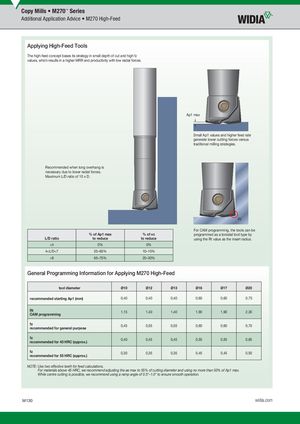
Applying High-Feed Tools
The high-feed concept bases its strategy in small depth of cut and high fz values, which results in a higher MRR and productivity with low radial forces.
Ap1 max
Small Ap1 values and higher feed rate generate lower cutting forces versus traditional milling strategies.
Recommended when long overhang is necessary due to lower radial forces. Maximum L/D ratio of 10 x D.
Rt
For CAM programming, the tools can be
| % of Ap1 max | % of vc | programmed as a toroidal tool type by | |
| L/D ratio | to reduce | to reduce | using the Rt value as the insert radius. |
| <4 | 0% | 0% | |
| 4<L/D<7 | 55–65% | 10–15% | |
| >8 | 65–75% | 20–30% |
General Programming Information for Applying M270 High-Feed
| tool diameter | Ø10 | Ø12 | Ø13 | Ø16 | Ø17 | Ø20 | |
| recommended starting Ap1 (mm) | 0,40 | 0,40 | 0,40 | 0,60 | 0,60 | 0,75 |
| tool diameter | Ø10 | Ø12 | Ø13 | Ø16 | Ø17 | Ø20 |
| recommended starting Ap1 (mm) | 0,40 | 0,40 | 0,40 | 0,60 | 0,60 | 0,75 |
| Rt CAM programming | 1,15 | 1,40 | 1,40 | 1,90 | 1,90 | 2,30 |
| fz recommended for general purpose | 0,45 | 0,55 | 0,55 | 0,60 | 0,60 | 0,70 |
| fz recommended for 45 HRC (approx.) | 0,40 | 0,45 | 0,45 | 0,55 | 0,55 | 0,65 |
| fz recommended for 55 HRC (approx.) | 0,30 | 0,35 | 0,35 | 0,45 | 0,45 | 0,50 |