Общий каталог PRECITOOL - страница 313
Навигация
Cubic boron nitride (CBN)
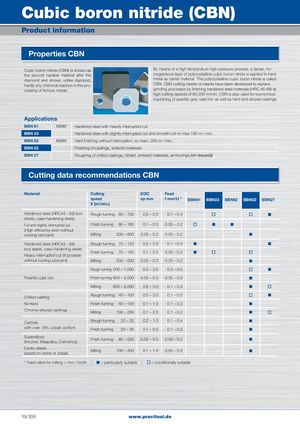
Properties CBN
| Cubic boron nitride (CBN) is known as Eigenschaften | By means of a high-temperature high-pressure process, a dense, ho- |
| the second hardest material after the | mogeneous layer of polycrystalline cubic boron nitride is applied to hard |
| diamond and shows, unlike diamond, | metal as carrier material. This polycrystalline cubic boron nitride is called |
| hardly any chemical reaction in the pro-CBN | CBN. CBN cutting inserts or inserts have been developed to replace |
| cessing of ferrous metals. | grinding processes by finishing hardened steel materials (HRC 45-68) at |
high cutting speeds of 80-200 m/min. CBN is also used for economical machining of pearlitic grey cast iron as well as hard and alloyed castings.
Applications
Kubisches Bornitrid (CBN) ist als das zweithärteste Mit Hilfe eines Hochtemperatur-Hochdruck-Verfahrens
| BBN 61 | NEW! | Hardened steel with heavily interrupted cutMaterial nach dem Diamanten bekannt und zeigt, wird eine dichte homogene Lage aus polykristallinem | |
| anders als Diamant kaum chemische Reaktion bei der | kubischem Bornitrid auf Hartmetall als Trägermaterial | ||
| BBN 33 | Hardened steel with slightly interrupted cut and smooth cut vc-max 180 m / min.Bearbeitung von Eisenmetallen.aufgebracht. Dieses polykristalline kubische Bornitrid | ||
| trägt die Bezeichnung CBN. | |||
| BBN 62 | NEW! | Hard finishing without interruption, vc-max> 200 m / min.CBN -Schneidplatten oder Einsätze wurden entwickelt |
um Schleifprozesse durch Feinbearbeitung gehärteter Stahlwerkstoffe (HRC 45-68) bei hohen Schnittge- BBN 02 Finishing of castings, sintered materialsschwindigkeiten von 80-200 m/min. zu ersetzen. Ebenso wird CBN bei der wirtschaftlichen Zerspanung
BBN 27 Roughing of chilled castings, NiHart, sintered materials, armourings von perlitischem Grauguß sowie harten und legierten (on request)) Gußsorten eingesetzt.
Cutting data recommendations CBN
Anwendungen
NEW! BBN 61 gehärteter Stahl mit stark unterbrochenem Schnitt
BBN 33 gehärteter Stahl mit leicht unterbrochenem Schnitt und Glattschnitt
| Material | Cutting speed V (m/min.) | DOC ap mm | Feed f mm/U | BBN61 | BBN33 | BBN62 | BBN02 | BBN27 |
| Hardened steel (HRC45 - 68) tool steels, case-hardening steels | Rough turning 80 – 130 | 0.5 – 2.0 | 0.1 – 0.4 | ■ | ||||
| Full and slightly interrupted cut i | Finish turning 80 – 180 | 0.1 – 0.5 | 0.03 – 0.2 | ■ | ■ | |||
| (High efficiency even without cooling lubricant) | Milling 200 – 600 | 0.05 – 0.3 | 0.03 – 0.2 | ■ | ||||
| Hardened steel (HRC45 - 68) | Rough turning 70 – 120 | 0.5 – 2.0 | 0.1 – 0.4 | ■ | ■ | |||
| tool steels, case-hardening steels Heavy interrupted cut (If possible | Finish turning 70 – 150 | 0.1 – 0.5 | 0.03 – 0.2 | ■ | ||||
| without cooling lubricant) | Milling 200 – 600 | 0.05 – 0.3 | 0.03 – 0.2 | ■ | ||||
| Rough turning500 – 1,000 | 0.5 – 3.0 | 0.3 – 0.5 | ■ | |||||
| Pearlitic cast iron | Finish turning600 – 2.000 | 0.05 – 0.5 | 0.05 – 0.5 | ■ | ||||
| Milling 600 – 2.000 | 0.5 – 3.0 | 0.1 – 0.3 | ■ | |||||
| Chilled casting | Rough turning 40 – 100 | 0.5 – 3.0 | 0.1 – 0.5 | ■ | ||||
| Ni-Hard | Finish turning 40 – 120 | 0.1 – 1.0 | 0.1 – 0.3 | ■ | ||||
| Chrome-alloyed castings | Milling 100 – 200 | 0.1 – 2.5 | 0.1 – 0.2 | ■ | ||||
| Carbide | Rough turning 20 – 30 | 0.2 – 1.0 | 0.1 – 0.4 | ■ | ||||
| with over 18% cobalt content | Finish turning 20 – 35 | 0.1 – 0.5 | 0.1 – 0.3 | ■ | ||||
| Superalloys (Inconel, Waspaloy, Colmonoy) | Finish turning 80 – 200 | 0.05 – 0.5 | 0.03 – 0.2 | ■ | ||||
| Exotic steels based on nickel or cobalt | Milling 100 – 300 | 0.1 – 1.5 | 0.05 – 0.3 | ■ |
* Feed rates for milling = mm / tooth | ■ = particularly suitable | = conditionally suitable