Каталог Iscar вращающийся инструмент 2017 - страница 839
Навигация
 Каталог Iscar токарные пластины ISO 2022
 Каталог Iscar инструмент для фрезерования
 Каталог Iscar решения для глубокого сверления
 Каталог Iscar полирующие фрезы
 Каталог Iscar новые продукты 2018
 Каталог Iscar концевые фрезы со сменными пластинами 2022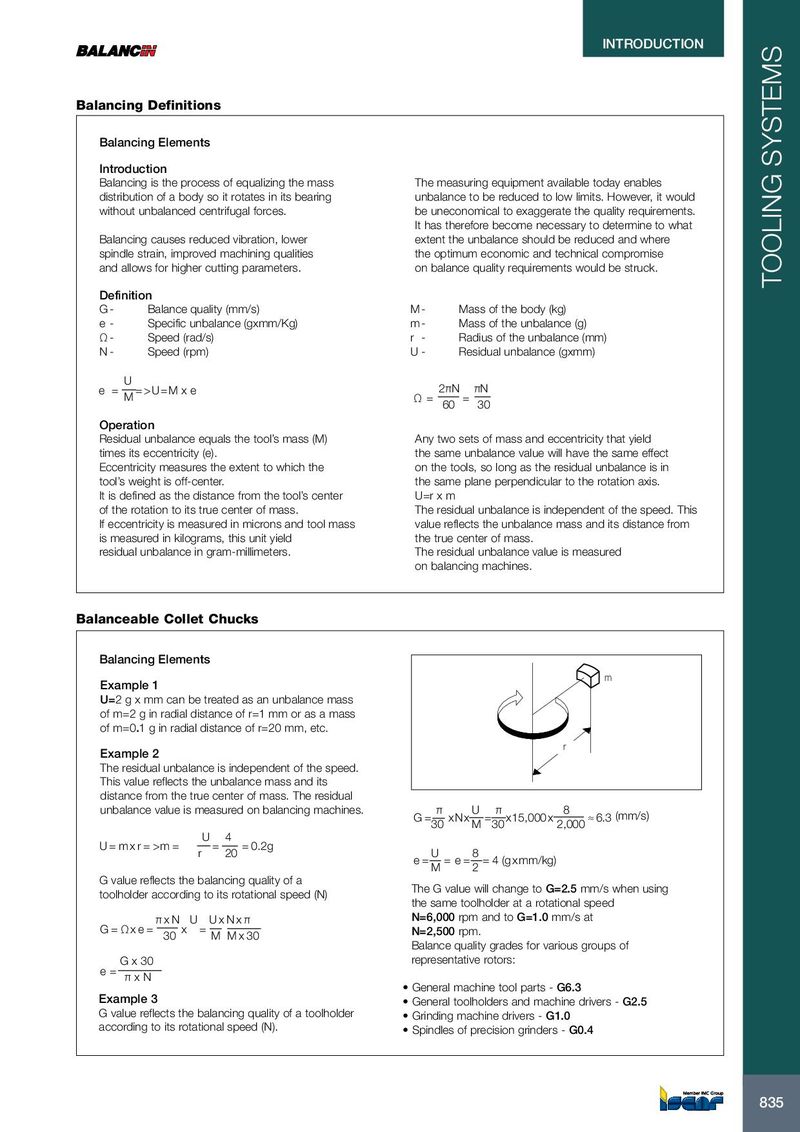
INTRODUCTION Balancing Definitions Balancing Elements Introduction Balancing is the process of equalizing the mass The measuring equipment available today enables distribution of a body so it rotates in its bearing unbalance to be reduced to low limits. However, it would without unbalanced centrifugal forces. be uneconomical to exaggerate the quality requirements. It has therefore become necessary to determine to what Balancing causes reduced vibration, lower extent the unbalance should be reduced and where spindle strain, improved machining qualities the optimum economic and technical compromise and allows for higher cutting parameters. on balance quality requirements would be struck. TOOLING SYSTEMS Definition G - Balance quality (mm/s) M - Mass of the body (kg) e - Specific unbalance (gxmm/Kg) m - Mass of the unbalance (g) Ω - Speed (rad/s) r - Radius of the unbalance (mm) N - Speed (rpm) U - Residual unbalance (gxmm) U e = =>U= M x e 2πN πN M Ω = = 60 30 Operation Residual unbalance equals the tool’s mass (M) Any two sets of mass and eccentricity that yield times its eccentricity (e). the same unbalance value will have the same effect Eccentricity measures the extent to which the on the tools, so long as the residual unbalance is in tool’s weight is off-center. the same plane perpendicular to the rotation axis. It is defined as the distance from the tool’s center U=r x m of the rotation to its true center of mass. The residual unbalance is independent of the speed. This If eccentricity is measured in microns and tool mass value reflects the unbalance mass and its distance from is measured in kilograms, this unit yield the true center of mass. residual unbalance in gram-millimeters. The residual unbalance value is measured on balancing machines. Balanceable Collet Chucks Balancing Elements m Example 1 U=2 g x mm can be treated as an unbalance mass of m=2 g in radial distance of r=1 mm or as a mass of m=0.1 g in radial distance of r=20 mm, etc. r Example 2 The residual unbalance is independent of the speed. This value reflects the unbalance mass and its distance from the true center of mass. The residual unbalance value is measured on balancing machines. π U π 8 G = xNx = x15,000 x ≈ 6.3 (mm/s) 30 M 30 2,000 U 4 U = m x r = >m = = = 0.2g r 2 0 U 8 e = = e = = 4 (g x mm/kg) M 2 G value reflects the balancing quality of a The G value will change to G=2.5 mm/s when using toolholder according to its rotational speed (N) the same toolholder at a rotational speed π x N U U x N x π N=6,000 rpm and to G=1.0 mm/s at G = Ω x e = x = N=2,500 rpm. 30 M M x 30 Balance quality grades for various groups of G x 30 representative rotors: e = π x N • General machine tool parts - G6.3 Example 3 • General toolholders and machine drivers - G2.5 G value reflects the balancing quality of a toolholder • Grinding machine drivers - G1.0 according to its rotational speed (N). • Spindles of precision grinders - G0.4 835 835