Каталог Iscar вращающийся инструмент 2017 - страница 703
Навигация
 Каталог Iscar токарные пластины ISO 2022
 Каталог Iscar инструмент для фрезерования
 Каталог Iscar решения для глубокого сверления
 Каталог Iscar полирующие фрезы
 Каталог Iscar новые продукты 2018
 Каталог Iscar концевые фрезы со сменными пластинами 2022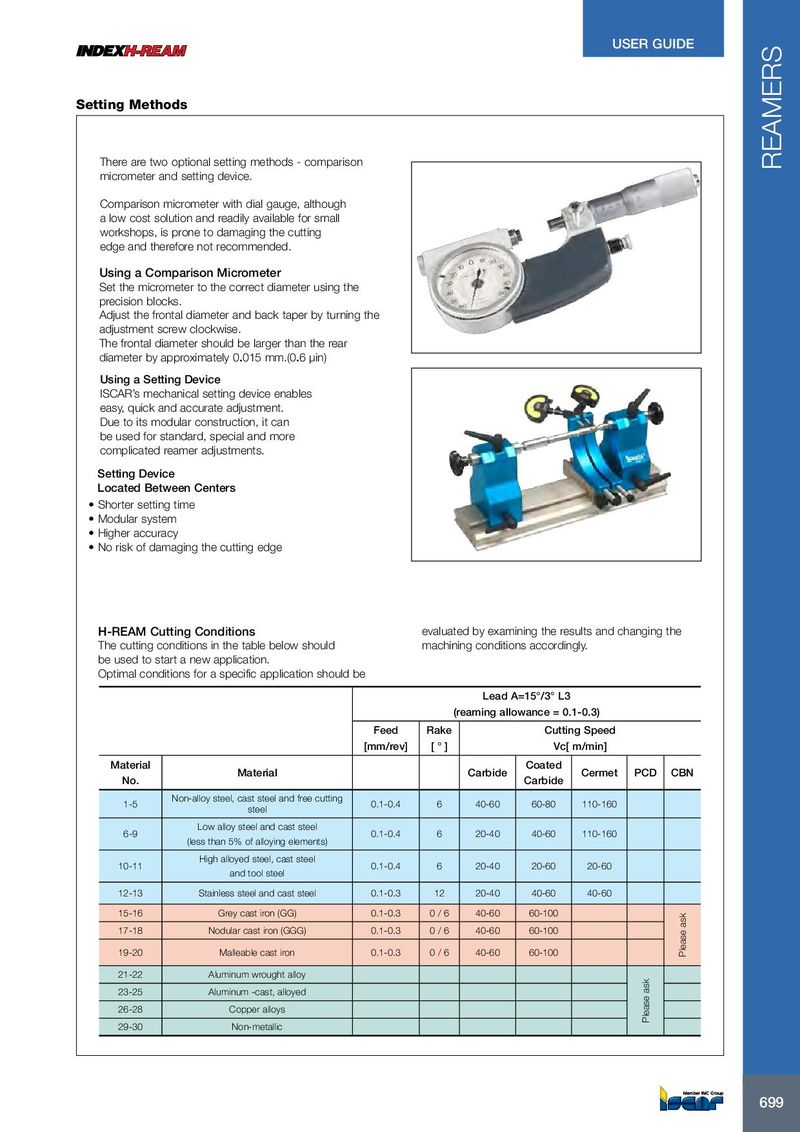
USER GUIDE Setting Methods There are two optional setting methods - comparison REAMERS micrometer and setting device. Comparison micrometer with dial gauge, although a low cost solution and readily available for small workshops, is prone to damaging the cutting edge and therefore not recommended. Using a Comparison Micrometer Set the micrometer to the correct diameter using the precision blocks. Adjust the frontal diameter and back taper by turning the adjustment screw clockwise. The frontal diameter should be larger than the rear diameter by approximately 0.015 mm.(0.6 µin) Using a Setting Device ISCAR’s mechanical setting device enables easy, quick and accurate adjustment. Due to its modular construction, it can be used for standard, special and more complicated reamer adjustments. Setting Device Located Between Centers • Shorter setting time • Modular system • Higher accuracy • No risk of damaging the cutting edge H-REAM Cutting Conditions evaluated by examining the results and changing the The cutting conditions in the table below should machining conditions accordingly. be used to start a new application. Optimal conditions for a specific application should be Lead A=15°/3° L3 (reaming allowance = 0.1-0.3) Feed Rake Cutting Speed [mm/rev] [ ° ] Vc[ m/min] Material Coated Material Carbide Cermet PCD CBN No. Carbide Non-alloy steel, cast steel and free cutting 1-5 0.1-0.4 6 40-60 60-80 110-160 steel Low alloy steel and cast steel 6-9 0.1-0.4 6 20-40 40-60 110-160 (less than 5% of alloying elements) High alloyed steel, cast steel 10-11 0.1-0.4 6 20-40 20-60 20-60 and tool steel 12-13 Stainless steel and cast steel 0.1-0.3 12 20-40 40-60 40-60 15-16 Grey cast iron (GG) 0.1-0.3 0 / 6 40-60 60-100 17-18 Nodular cast iron (GGG) 0.1-0.3 0 / 6 40-60 60-100 19-20 Malleable cast iron 0.1-0.3 0 / 6 40-60 60-100 Please ask 21-22 Aluminum wrought alloy 23-25 Aluminum -cast, alloyed 26-28 Copper alloys Please ask 29-30 Non-metallic 699 699