Каталог Iscar токарный инструмент 2017 - страница 350
Навигация
 Каталог Iscar резьбонарезные фрезы
 Каталог Iscar инструмент для обработки алюминиевых колёс
 Каталог Iscar державки и пластины для нарезания резьбы 2022
 Каталог Iscar расточные системы 2022
 Каталог Iscar высокоточные развертки и метчики 2022
 Токарные инструменты Iscar (часть 2) 2026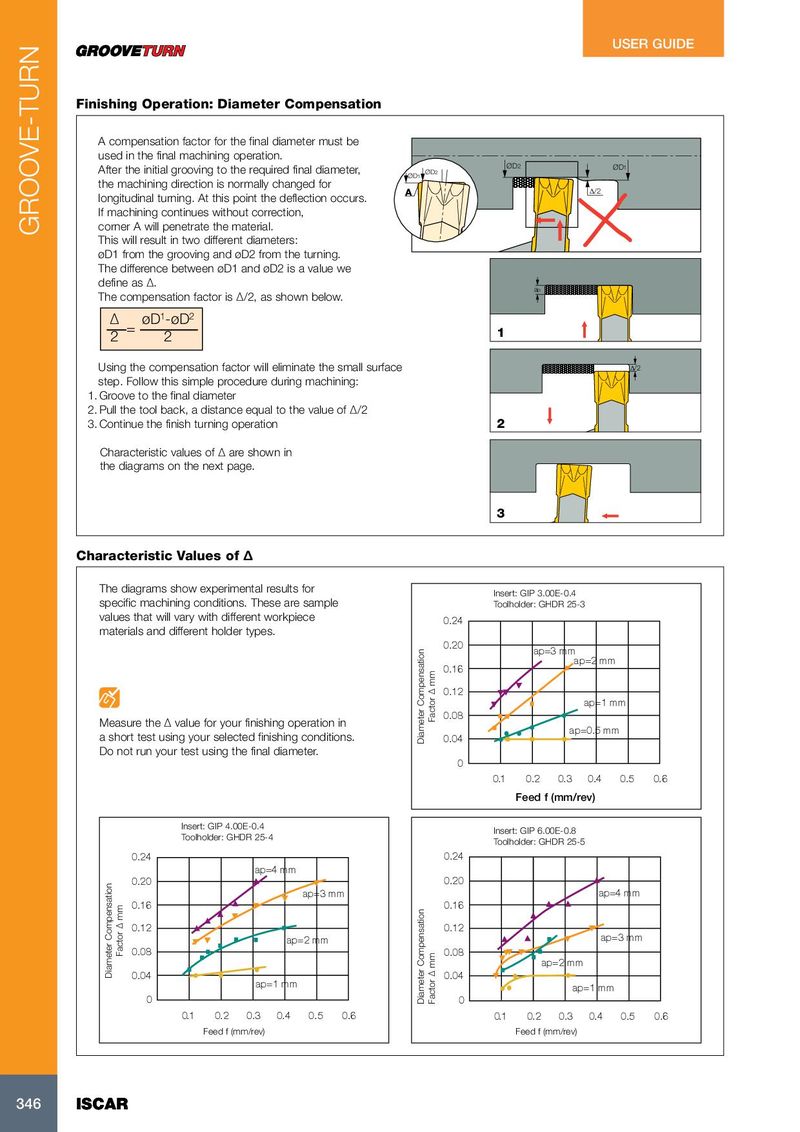
Finishing Operation: Diameter Compensation
A compensation factor for the final diameter must be used in the final machining operation.
| After the initial grooving to the required final diameter, | ØD2 | ØD1 | ||
| ØD | ØD2 | |||
| the machining direction is normally changed for | 1 |
longitudinal turning. At this point the deflection occurs. A Δ/2
If machining continues without correction, corner A will penetrate the material. This will result in two different diameters: øD1 from the grooving and øD2 from the turning.
The difference between øD1 and øD2 is a value we define as ∆. The compensation factor is ∆/2, as shown below. ap
∆ øD1-øD2
= 1
2 2
Using the compensation factor will eliminate the small surface /2 Δ step. Follow this simple procedure during machining: 1. Groove to the final diameter 2. Pull the tool back, a distance equal to the value of ∆/2
3. Continue the finish turning operation 2
Characteristic values of ∆ are shown in the diagrams on the next page.
3
Characteristic Values of ∆
The diagrams show experimental results for Insert: GIP 3.00E-0.4 specific machining conditions. These are sample Toolholder: GHDR 25-3 values that will vary with different workpiece 0.24 materials and different holder types. 0.20 ap=3 mm ap=2 mm 0.16 0.12 ap=1 mm 0.08 Measure the ∆ value for your finishing operation in a short test using your selected finishing conditions. ap=0.5 mm 0.04 Do not run your test using the final diameter. 0
0.1 0.2 0.3 0.4 0.5 0.6
Feed f (mm/rev) Insert: GIP 4.00E-0.4 Insert: GIP 6.00E-0.8 Toolholder: GHDR 25-4 Toolholder: GHDR 25-5 0.24 0.24
ap=4 mm 0.20 0.20 ap=3 mm ap=4 mm 0.16 0.16 0.12 0.12 ap=2 mm ap=3 mm 0.08 0.08 ap=2 mm 0.04 0.04 ap=1 mm ap=1 mm 0 0
0.1 0.2 0.3 0.4 0.5 0.6 0.1 0.2 0.3 0.4 0.5 0.6
Feed f (mm/rev) Feed f (mm/rev)