Каталог Iscar дисковые фрезы и фрезерные пластины 2022 - страница 64
Навигация
 Каталог Iscar крепление инструмента
 Каталог Iscar инструмент для обработки отверстий
 Каталог Iscar резьбонарезные фрезы
 Каталог Iscar инструмента для сверления
 Каталог Iscar решения для глубокого сверления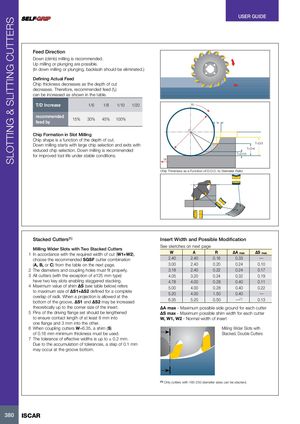
Feed Direction
Down (climb) milling is recommended. Up milling or plunging are possible. (In down milling or plunging, backlash should be eliminated.) Defining Actual Feed Chip thickness decreases as the depth of cut decreases. Therefore, recommended feed (f ) z can be increased as shown in the table.
| T/D Increase 1/6 1/8 1/10 1/20 recommended feed by 15% 30% 45% 100% | fz Vc | |
| hip Formation in Slot Milling | D | |
| hip shape is a function of the depth of cut. own milling starts with large chip selection and exits with duced chip selection. Down milling is recommended r improved tool life under stable conditions. | Vf Chip Thickness as a Function of D.O.C. to Diame | T=D/3 T=D/4 T=D/10 ter Ratio |
Stacked Cutters(1) Insert Width and Possible Modification
See sketches on next page Milling Wider Slots with Two Stacked Cutters
| W | A | R | ∆Amax | ∆Smax |
| 2.40 | 2.40 | 0.16 | 0.33 | — |
| 3.00 | 2.40 | 0.20 | 0.24 | 0.10 |
| 3.18 | 2.40 | 0.22 | 0.24 | 0.17 |
| 4.05 | 3.20 | 0.24 | 0.32 | 0.19 |
| 4.78 | 4.00 | 0.28 | 0.40 | 0.11 |
| 5.00 | 4.00 | 0.28 | 0.40 | 0.22 |
| 5.20 | 4.00 | 1.50 | 0.40 | — |
| 6.35 | 5.20 | 0.50 | —(1) | 0.13 |
overlap of radii. When a projection is allowed at the bottom of the groove, ∆S1 and ∆S2 may be increased theoretically up to the corner size of the insert. ∆A max - Maximum possible side ground for each cutter 5 Pins of the driving flange set should be lengthened ∆S max - Maximum possible shim width for each cutter to ensure contact length of at least 8 mm into W, W1, W2 - Normal width of insert one flange and 3 mm into the other. 6 When coupling cutters W=6.35, a shim (S) Milling Wider Slots with of 0.16 mm minimum thickness must be used. Stacked, Double Cutters 7 The tolerance of effective widths is up to ± 0.2 mm. Due to the accumulation of tolerances, a step of 0.1 mm may occur at the groove bottom.
(1) Only cutters with 160-250 diameter sizes can be stacked.