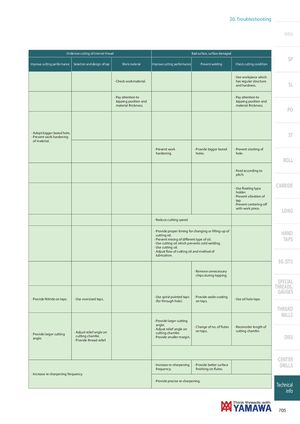
| Und Improve cutting performance | ersize cutting of internal threa Selection and design of tap | d Work material | B Improve cutting performance | ad surface, surface damaged Prevent welding | Check cutting condition | SP |
| | ∙ Check workmaterial. | | | ∙ Use workpiece which has regular structure and hardness. | SL |
| | ∙ Pay attention to tapping position and material thickness. | | | ∙ Pay attention to tapping position and material thickness. | PO |
| ∙ Adopt bigger bored hole. ∙ Prevent work hardening of material | | | | | | ST |
| . | | | ∙ Prevent work hardening. | ∙ Provide bigger bored holes. | ∙ Prevent slanting of hole. | ROLL |
| | | | | ∙ Feed according to pitch. | |
| | | | | ∙ Use fl oating type holder. ∙ Prevent vibration of tap. ∙ Prevent centering-off with work piece. | CARBIDE LONG |
| | | ∙ Reduce cutting speed | | | |
| | | ∙ Provide proper timing for i cutting oil. ∙ Prevent mixing of diff ere ∙ Use cutting oil which pre ∙ Use cutting oil. ∙ Adjust fl ow of cutting oil lubrication. | changing or fi lling-up of f nt type of oil. vents cold welding. l and method of | | HAND TAPS EG (STI) |
| ∙ Provide Nitride on taps. | ∙ Use oversized taps. | | ∙ Use spiral pointed taps (for through hole). | ∙ Remove unnecessary chips during tapping. ∙ Provide oxide coating on taps. | ∙ Use oil hole taps. | SPECIAL THREADS, GAUGES THREAD |
| ∙ Provide larger cutting angle. | ∙ Adjust relief angle on cutting chamfer. ∙ Provide thread relief. | | ∙ Provide larger cutting angle. ∙ Adjust relief angle on cutting chamfer. ∙ Provide smaller margin. | ∙ Change of no. of fl utes on taps. | ∙ Reconsider length of cutting chamfer. | MILLS DIES |
| ∙ Increase re-sharpening freq | uency. | | ∙ Increase re-sharpening frequency. ∙ Provide precise re-sharpe | ∙ Provide better surface fi nishing on fl utes. ning. | | CENTER DRILLS Technical info |
 Обший каталог Yamawa 2016 - 2017
 Краткое руководство Yamawa по каталогам
 Общий каталог Yamawa 2022 - 2023
 Каталоги Yamawa твердосплавные метчики для закаленной стали