Общий каталог Widia 2017 - страница 685
Навигация
 Каталог Widia токарный инструмент 2017
 Каталог Widia трохоидальное фрезерование
 Каталог Widia техническое руководство по разверткам
 Каталог Widia фрезы со сменными пластинами 2016
 Каталог Widia достижения 2020
- Table of Contents
- Turning
- Turning • ISO Inserts
- Turning • Tools for External Turning and Internal Boring
- Turning • Tools for External Turning and Internal Boring
- Turning • Tools for Small Hole Boring
- com E1Turning • Grooving and Cut-Off
- Turning • Threading
- Indexable Milling
- Indexable Milling • Face Mills
- Indexable Milling • Chamfer Mills
- Indexable Milling • 90° Shoulder Mills
- Indexable Milling • Helical Mills
- Indexable Milling • Slotting Mills
- Indexable Milling • Copy Mills
- Solid End Milling
- Solid End Milling • High-Performance Solid Carbide End Mills
- Solid End Milling • General Purpose Solid Carbide End Mills
- Solid End Milling • High-Performance High-Speed Steel (HSS-E/PM)
- Solid End Milling • Burs
- Holemaking
- Holemaking • High-Performance Solid Carbide Drills
- Holemaking • Modular Drills
- Holemaking • Indexable Drills
- Holemaking • Modular Drills
- Holemaking • Indexable Drills
- Holemaking • Hole Finishing
- Tapping
- Tapping Portfolio
- Index by Order Number
- Index by Catalogue Number
- Global Contacts
- Informational Icons Guide
- Material Overview • DIN
Threading
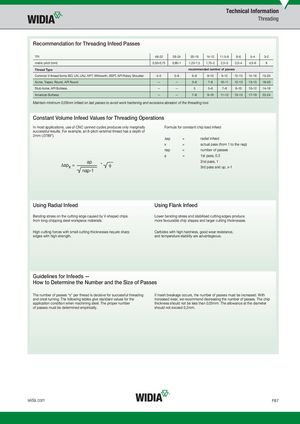
Recommendation for Threading Infeed Passes
| TPI | 48–32 | 28–24 | 20–16 | 14–12 | 11.5–9 | 8–6 | 5–4 | 3–2 | |
| metric pitch (mm) | 0,50–0,75 | 0,80–1 | 1,25–1,5 | 1,75–2 | 2,5–3 | 3,5–4 | 4,5–6 | 8 | |
| Thread Type | recommended number of passes | ||||||||
| Common V-thread forms ISO, UN, UNJ, NPT, Whitworth, BSPT, API Rotary Shoulder | 4–5 | 5–6 | 6–8 | 8–10 | 9–12 | 12–15 | 14–16 | 15–25 | |
| Acme, Trapez, Round, API Round | — | — | 5–6 | 7–8 | 10–11 | 12–13 | 13–15 | 18–20 | |
| Stub Acme, API Buttress | — | — | 5 | 5–6 | 7–8 | 8–10 | 10–12 | 14–16 | |
| American Buttress | — | — | 7–8 | 9–10 | 11–12 | 13–15 | 17–19 | 22–24 |
Maintain minimum 0,05mm infeed on last passes to avoid work hardening and excessive abrasion of the threading tool.
Constant Volume Infeed Values for Threading Operations
In most applications, use of CNC canned cycles produces only marginally Formula for constant chip load infeed
successful results. For example, an 8-pitch external thread has a depth of
2mm (.0789").
6ap = radial infeed
| x | = | actual pass (from 1 to the nap) | |
| nap | = | number of passes | |
| q | = | 1st pass, 0.3 | |
| ap | 2nd pass, 1 |
6apx = * q
3rd pass and up, x-1 nap-1
| Using Radial Infeed | Using Flank Infeed |
| Bending stress on the cutting edge caused by V-shaped chips | Lower bending stress and stabilised cutting edges produce |
| from long-chipping steel workpiece materials. | more favourable chip shapes and larger cutting thicknesses. |
| High cutting forces with small cutting thicknesses require sharp | Carbides with high hardness, good wear resistance, |
| edges with high strength. | and temperature stability are advantageous. |
Guidelines for Infeeds —
How to Determine the Number and the Size of Passes
| The number of passes “s” per thread is decisive for successful threading | If insert breakage occurs, the number of passes must be increased. With |
| and crest turning. The following tables give standard values for the | increased wear, we recommend decreasing the number of passes. The chip |
| application condition when machining steel. The proper number | thickness should not be less than 0,05mm. The allowance at the diameter |
| of passes must be determined empirically. | should not exceed 0,2mm. |