Общий каталог Widia 2017 - страница 1806
Навигация
 Каталог Widia токарный инструмент 2017
 Каталог Widia трохоидальное фрезерование
 Каталог Widia техническое руководство по разверткам
 Каталог Widia фрезы со сменными пластинами 2016
 Каталог Widia достижения 2020
- Table of Contents
- Turning
- Turning • ISO Inserts
- Turning • Tools for External Turning and Internal Boring
- Turning • Tools for External Turning and Internal Boring
- Turning • Tools for Small Hole Boring
- com E1Turning • Grooving and Cut-Off
- Turning • Threading
- Indexable Milling
- Indexable Milling • Face Mills
- Indexable Milling • Chamfer Mills
- Indexable Milling • 90° Shoulder Mills
- Indexable Milling • Helical Mills
- Indexable Milling • Slotting Mills
- Indexable Milling • Copy Mills
- Solid End Milling
- Solid End Milling • High-Performance Solid Carbide End Mills
- Solid End Milling • General Purpose Solid Carbide End Mills
- Solid End Milling • High-Performance High-Speed Steel (HSS-E/PM)
- Solid End Milling • Burs
- Holemaking
- Holemaking • High-Performance Solid Carbide Drills
- Holemaking • Modular Drills
- Holemaking • Indexable Drills
- Holemaking • Modular Drills
- Holemaking • Indexable Drills
- Holemaking • Hole Finishing
- Tapping
- Tapping Portfolio
- Index by Order Number
- Index by Catalogue Number
- Global Contacts
- Informational Icons Guide
- Material Overview • DIN
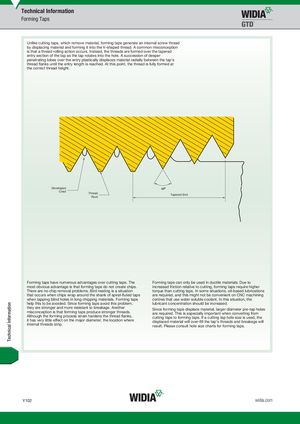
Forming Taps
Unlike cutting taps, which remove material, forming taps generate an internal screw thread by displacing material and forming it into the V-shaped thread. A common misconception is that a thread rolling action occurs. Instead, the threads are formed over the tapered entry section of the tap as the tap rotates into the hole. A succession of deeper penetrating lobes over the entry plastically displaces material radially between the tap’s thread fl anks until the entry length is reached. At this point, the thread is fully formed at the correct thread height.
Developed Crest
Thread Tapered End Root
| Forming taps have numerous advantages over cutting taps. The | Forming taps can only be used in ductile materials. Due to |
| most obvious advantage is that forming taps do not create chips. | increased friction relative to cutting, forming taps require higher |
| There are no chip removal problems. Bird nesting is a situation | torque than cutting taps. In some situations, oil-based lubrications |
| that occurs when chips wrap around the shank of spiral-fl uted taps | are required, and this might not be convenient on CNC machining |
| when tapping blind holes in long chipping materials. Forming taps | centres that use water soluble coolant. In this situation, the |
| help this to be avoided. Since forming taps avoid this problem, | lubricant concentration should be increased. |
| they are stronger and more resistant to breakage. Another | Since forming taps displace material, larger diameter pre-tap holes |
| misconception is that forming taps produce stronger threads. | |
| are required. This is especially important when converting from | |
| Although the forming process strain hardens the thread fl anks, | cutting taps to forming taps. If a cutting tap hole size is used, the |
| it has very little effect on the major diameter, the location where | |
| displaced material will over-fi ll the tap’s threads and breakage will | |
| internal threads strip. | result. Please consult hole size charts for forming taps. |