Общий каталог Widia 2017 - страница 1484
Навигация
 Каталог Widia токарный инструмент 2017
 Каталог Widia трохоидальное фрезерование
 Каталог Widia техническое руководство по разверткам
 Каталог Widia фрезы со сменными пластинами 2016
 Каталог Widia достижения 2020
- Table of Contents
- Turning
- Turning • ISO Inserts
- Turning • Tools for External Turning and Internal Boring
- Turning • Tools for External Turning and Internal Boring
- Turning • Tools for Small Hole Boring
- com E1Turning • Grooving and Cut-Off
- Turning • Threading
- Indexable Milling
- Indexable Milling • Face Mills
- Indexable Milling • Chamfer Mills
- Indexable Milling • 90° Shoulder Mills
- Indexable Milling • Helical Mills
- Indexable Milling • Slotting Mills
- Indexable Milling • Copy Mills
- Solid End Milling
- Solid End Milling • High-Performance Solid Carbide End Mills
- Solid End Milling • General Purpose Solid Carbide End Mills
- Solid End Milling • High-Performance High-Speed Steel (HSS-E/PM)
- Solid End Milling • Burs
- Holemaking
- Holemaking • High-Performance Solid Carbide Drills
- Holemaking • Modular Drills
- Holemaking • Indexable Drills
- Holemaking • Modular Drills
- Holemaking • Indexable Drills
- Holemaking • Hole Finishing
- Tapping
- Tapping Portfolio
- Index by Order Number
- Index by Catalogue Number
- Global Contacts
- Informational Icons Guide
- Material Overview • DIN
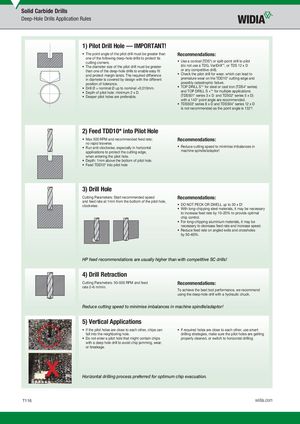
Deep-Hole Drills Application Rules
1) Pilot Drill Hole — IMPORTANT!
- The point angle of the pilot drill must be greater than Recommendations: one of the following deep-hole drills to protect its cutting corners. Use a conical (TDS*) or split-point drill to pilot
- The diameter size of the pilot drill must be greater (do not use a TDG, VariDrill™, or TDS 12 x D than one of the deep-hole drills to enable easy fi t or any competitive drill). and protect margin lands. The required difference Check the pilot drill for wear, which can lead to in diameter is covered by design with the different premature wear on the TDD10* cutting edge and position of tolerance. possibly catastrophic failure.
- Drill Ø = nominal Ø up to nominal +0,010mm.
- TOP DRILL S™ for steel or cast iron (TDS4* series)
- Depth of pilot hole: minimum 2 x D. and TOP DRILL S +™ for multiple applications
- Deeper pilot holes are preferable. (TDS501* series 3 x D and TD502* series 5 x D)
with a 140° point angle are recommended.
- TDS503* series 8 x D and TDS504* series 12 x D is not recommended as the point angle is 132°!
2) Feed TDD10* into Pilot Hole
- Max 500 RPM and recommended feed rate; Recommendations: no rapid traverse.
- Run anti-clockwise, especially in horizontal
- Reduce cutting speed to minimise imbalances in
applications to protect the cutting edge, machine spindle/adaptor! when entering the pilot hole.
- Depth: 1mm above the bottom of pilot hole.
- Feed TDD10* into pilot hole
3) Drill Hole
Cutting Parameters: Start recommended speed Recommendations: and feed rate at 1mm from the bottom of the pilot hole, clockwise. DO NOT PECK OR DWELL up to 30 x D!
- With long-chipping steel materials, it may be necessary to increase feed rate by 10–20% to provide optimal chip control.
- For long-chipping aluminium materials, it may be necessary to decrease feed rate and increase speed.
- Reduce feed rate on angled exits and crossholes by 50–60%.
HP feed recommendations are usually higher than with competitive SC drills!
4) Drill Retraction
Cutting Parameters: 50–500 RPM and feed Recommendations:
rate 2–6 m/min. To achieve the best tool performance, we recommend using the deep-hole drill with a hydraulic chuck.
Reduce cutting speed to minimise imbalances in machine spindle/adaptor!
5) Vertical Applications
- If the pilot holes are close to each other, chips can
- If required holes are close to each other, use smart
fall into the neighboring hole. drilling strategies, make sure the pilot holes are getting
- Do not enter a pilot hole that might contain chips properly cleaned, or switch to horizontal drilling. with a deep hole drill to avoid chip jamming, wear, or breakage.
Horizontal drilling process preferred for optimum chip evacuation.
LWID_Master16_Holemaking_SolidCarbideDrills_T116_T117_Metric_REBRAND.indd 116ViWID M16 H lkiS lidC bid D ill T116 T117 M i REBRANDD b 15 201510 27AM 12/15/15 10:27 AM