Каталог Widia инструментальная оснастка - страница 1107
Навигация
 Каталог Widia достижения 2021
 Брошюра Widia решения для аэрокосмической промышленности
 Брошюра Widia техническое руководство
 Каталог Widia токарный инструмент 2020
 Каталог Widia цельные концевые фрезы
 Каталог Widia техническое руководство по разверткам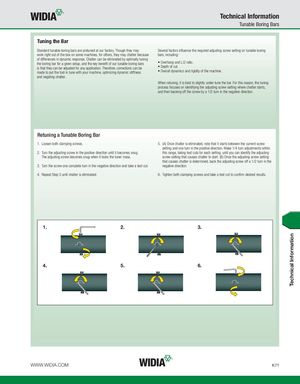
Tuning the Bar
| Standard tunable boring bars are pretuned at our factory. Though they may | Several factors influence the required adjusting screw setting on tunable boring |
| work right out of the box on some machines, for others, they may chatter because | bars, including: |
| of differences in dynamic response. Chatter can be eliminated by optimally tuning | |
| the boring bar for a given setup, and the key benefit of our tunable boring bars | • Overhang and L:D ratio. |
| is that they can be adjusted for any application. Therefore, corrections can be | • Depth of cut. |
| made to put the tool in tune with your machine, optimizing dynamic stiffness | • Overall dynamics and rigidity of the machine. |
and negating chatter. When retuning, it is best to slightly under-tune the bar. For this reason, the tuning process focuses on identifying the adjusting screw setting where chatter starts, and then backing off the screw by a 1/2 turn in the negative direction.
Retuning a Tunable Boring Bar
| 1. Loosen both clamping screws. | 5. (A) Once chatter is eliminated, note that it starts between the current screw |
| setting and one turn in the positive direction. Make 1/4 turn adjustments within | |
| 2. Turn the adjusting screw in the positive direction until it becomes snug. | this range, taking test cuts for each setting, until you can identify the adjusting |
| The adjusting screw becomes snug when it locks the tuner mass. screw setting that causes chatter to start. (B) Once the adjusting screw setting | |
| that causes chatter is determined, back the adjusting screw off a 1/2 turn in the | |
| 3. Turn the screw one complete turn in the negative direction and take a test cut. | negative direction. |
4. Repeat Step 3 until chatter is eliminated. 6. Tighten both clamping screws and take a test cut to confirm desired results.
1. 2. 3.
4. 5. 6.