Каталог Widia инструментальная оснастка - страница 1083
Навигация
 Каталог Widia достижения 2021
 Брошюра Widia решения для аэрокосмической промышленности
 Брошюра Widia техническое руководство
 Каталог Widia токарный инструмент 2020
 Каталог Widia цельные концевые фрезы
 Каталог Widia техническое руководство по разверткам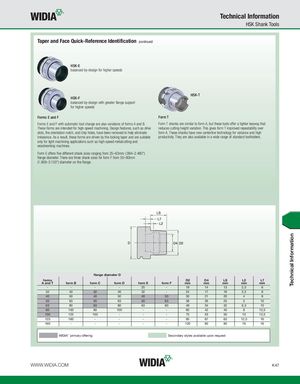
HSK Shank Tools
Taper and Face Quick-Reference Identification
(continued)
HSK-E
balanced-by-design for higher speeds
HSK-T
HSK-F
balanced-by-design with greater flange support
for higher speeds
| Forms E and F | Form T |
| Forms E and F with automatic tool change are also variations of forms A and B. | Form T shanks are similar to form A, but these tools offer a tighter keyway that |
| These forms are intended for high-speed machining. Design features, such as drive | reduces cutting height variation. This gives form T improved repeatability over |
| slots, the orientation notch, and chip holes, have been removed to help eliminate | form A. These shanks have new centerline technology for variance and high |
| imbalance. As a result, these forms are driven by the locking taper and are suitable | productivity. They are also available in a wide range of standard toolholders. |
only for light machining applications such as high-speed metalcutting and woodworking machines. Form E offers five different shank sizes ranging from 25–63mm (.984–2.480") flange diameter. There are three shank sizes for form F from 50–80mm
(1.969–3.150") diameter on the flange.
flange diameter D
| forms | D2 | D4 | LS | L2 | L7 | |||||
| AandT | form B | form C | form D | form E | form F | mm | mm | mm | mm | mm |
| - | - | - | - | 25 | - | 19 | 14 | 13 | 2,5 | 6 |
| 32 | 40 | 32 | 40 | 32 | - | 24 | 17 | 16 | 3,2 | 8 |
| 40 | 50 | 40 | 50 | 40 | 50 | 30 | 21 | 20 | 4 | 8 |
| 50 | 63 | 50 | 63 | 50 | 63 | 38 | 26 | 25 | 5 | 10 |
| 63 | 80 | 63 | 80 | 63 | 80 | 48 | 34 | 32 | 6,3 | 10 |
| 80 | 100 | 80 | 100 | - | - | 60 | 42 | 40 | 8 | 12,5 |
| 100 | 125 | 100 | - | - | - | 75 | 53 | 50 | 10 | 12,5 |
| 125 | 160 | - | - | - | - | 95 | 67 | 63 | 12,5 | 16 |
| 160 | - | - | - | - | - | 120 | 85 | 80 | 16 | 16 |
WIDIA™ primary offering Secondary styles available upon request