| Trouble | | Basic Remedies | | Remedy Examples | |
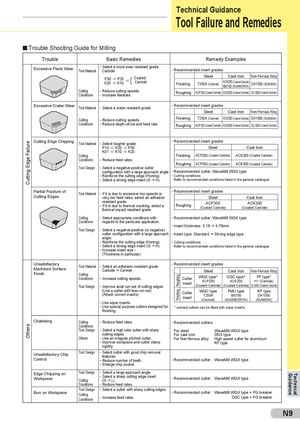
| Excessive Flank Wear | Tool Material | - Select a more wear resistant grade. Carbide | - Recommen | ded insertgrades | |
| | Ctd | | Steel Cast Iron | Non-Ferrous Alloy |
| | P30 aP20 a {oae K20 aK10 Cermet | Finishing | T250A(Cermet) ACK200(Coated Carbide BN700 (SUMIBORON | DA1000(SUMIDIA) ) ) |
| Cutting Conditions | - Reduce cutting speeds. - Increase feedrate. | Roughing | ACK200(Coated Carbide ACP100(Coated Carbide) | ) DL1000(Coated Carbide) |
| Excessive Crater Wear | Tool Material | - Select a crater resistant grade. | - Recommen | ded insertgrades Steel Cast Iron | Non-Ferrous Alloy |
| Cutting Conditions | - Reduce cutting speeds. - Reduce depth-of-cut and feed rate. | Finishing Roughing | T250A(Cermet) ACP100(Coated Carbide) ACK200(Coated Carbide ACK200(Coated Carbide | DA1000(SUMIDIA) ) ) DL1000(Coated Carbide) |
| ure Cutting Edge Chipping | Tool Material | - Select tougher grade. | - Recommen | ded insertgrades Stl | t I |
| ail | | P10 aP20 aP30 | | ee | as ron |
| ge F | Cutting Conditions | K01 aK10 aK20 - Reduce feed rates. | Finishing | ACP200(Coated Carbide) ACK200 | (Coated Carbide) |
| CuttingEd | Tool Design | - Select a negative-positive cutter configuration with a large approach angle. - Reinforce the cutting edge (Honing). - Select a strong edge insert (G gH). | - Recommen -Cutting condi Refer to reco Roughing | ded cutter: WaveMill WGX type tions: mmended conditions listed in the gen ACP300(Coated Carbide) ACK300 | eral catalogue (Coated Carbide) |
| Partial Fracture of Cutting Edges | Tool Material | - If it is due to excessive low speeds or very low feed rates, select an adhesion | - Recommen | ded insertgrades Steel C | ast Iron |
| Cutting Conditions Tool Design | resistant grade. - If it is due to thermal cracking, select a thermal impact resistant grade. - Select appropriate conditions with regards to the particular application. - Select a negative-positive (or negative) cutter configuration with a large approach angle. - Reinforce the cutting edge (Honing). - Select a strong edge insert (G gH). - Increase insert size - (Thickness in particular). | - Recommen - Insert thickn - Insert type: -Cutting condi Refer to reco Roughing | ded cutter: WaveMill WGX type ess: 3,18g 4,76mm Standardg Strong edge type tions: mmended conditions listed in the gen ACP300 (Coated Carbide) (Coa | eral catalogue ACK300 ted Carbide) |
| Unsatisfactory Machined Surface Finish | Tool Material Cutting Conditions Tl Di | - Select an adhesion resistant grade. CarbidegCermet - Increase cutting speeds. Iiltfttid | - Recommen Cutter Insert Roughing | ded insert grades Steel Cast Iron WGX type ACP200 (Coated Carbide) DGC type ACK200 (Coated Carbide) | Non-Ferrous Alloy FF type H1 (Carbide) DL1000(Coated Carbide) |
| oo esgn | - mprove axa run-ou o cung eges. (Use a cutter with less run-out) (Attach correct inserts) - Use wiper inserts. - Use special purpose cutters designed for finishing. | Cutter Insert Finishing marked cut i | WGC type T250A (Cermet) ters can be fitted with wiper inserts. FMU type BN700 (SUMIBORON) | RF type DA1000 (SUMIDIA) |
| Others Chattering | Cutting Conditions Tool Design Others | - Reduce feed rates. - Select a high rake cutter with sharp cutting edges - Use an irregular pitched cutter. - Improve workpiece and cutter clamp rigidity. | - Recommen For steel: For cast iro For Non-ferr | ded cutters: WaveMill WGX type n: DNX type ous alloy: High speed cutter for RF type | aluminium |
| Unsatisfactory Chip Control | Tool Design | - Select cutter with good chip removal features. - Reduce number of teeth. - Enlarge chip pocket. | - Recommen | ded cutter: WaveMill WGX type | |
| Edge Chipping on Workpiece | Tool Design Cutting Conditions | - Select a large approach angle. - Select a sharp cutting edge insert (G gL). - Reduce feed rates. | - Recommen | ded cutter: WaveMill WGX type | |
| Burr on Workpiece | Tool Design Cutting Conditions | - Select a cutter with sharp cutting edges. - Increase feed rates. | - Recommen | ded cutter: WaveMill WGX type DGC type | + FG breaker + FG breaker |
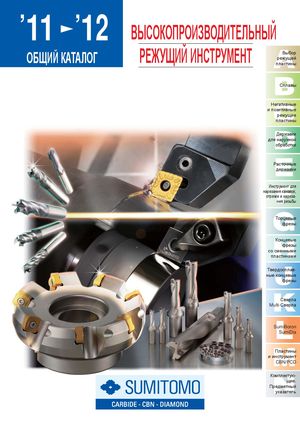 Общий каталог Sumitomo 2012
 Каталог Sumitomo резьбонарезной инструмент
 Каталог Sumitomo пластины с режущей кромкой-моноалмаз Sumicristal
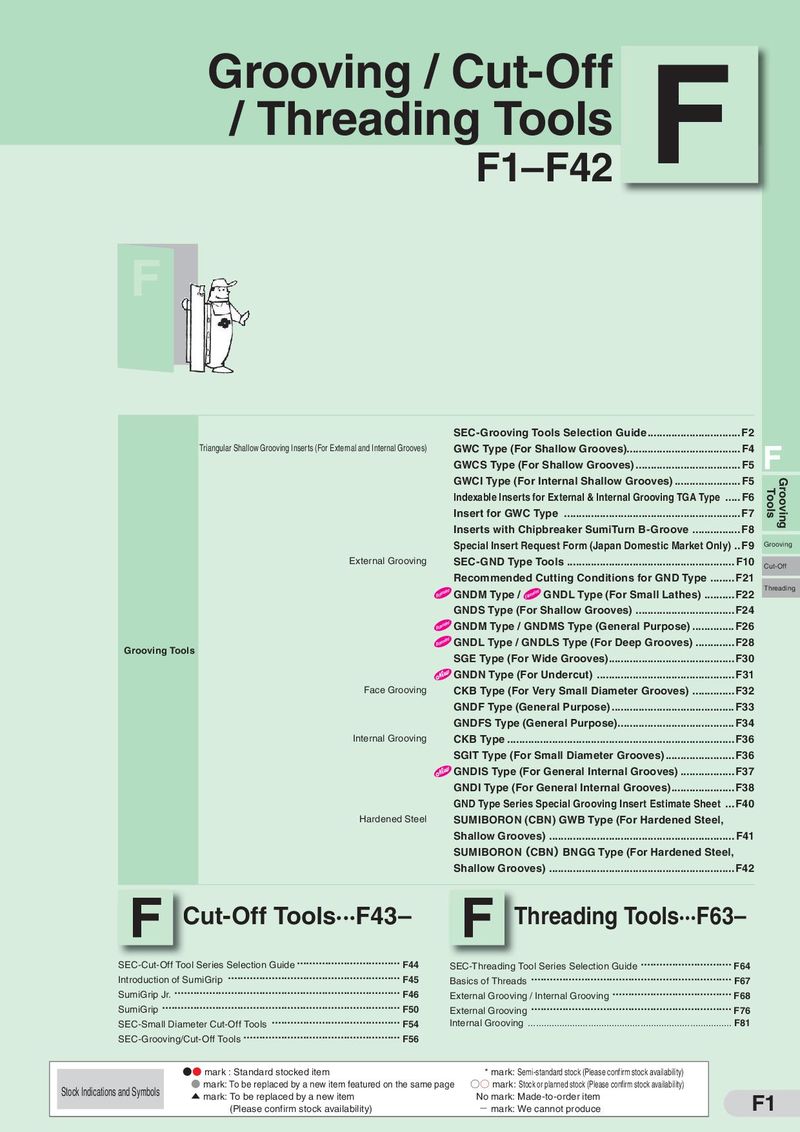 Каталог Sumitomo инструмент для обработки канавок
 Общий каталог Sumitomo 2019 - 2020
 Каталог Sumitomo запасные части