Общий каталог Sumitomo 2018 - 2019 - страница 562
Навигация
 Общий каталог Sumitomo 2012
 Каталог Sumitomo резьбонарезной инструмент
 Каталог Sumitomo пластины с режущей кромкой-моноалмаз Sumicristal
 Каталог Sumitomo инструмент для обработки канавок
 Общий каталог Sumitomo 2019 - 2020
 Каталог Sumitomo запасные части
- Pages 3-6_CS6_EN_web
- A 1-20 insert selection EN_web
- B 1-14 grades_EN_web
- C01-17 inserts intro pages_EN_web
- C18-56 negative inserts_EN_web
- C57-86 positive inserts_EN_web
- D 1-46 tool holders_EN_web
- E 1-24 boring bars_EN_web
- F 1-48 grooving_thread tools_EN_web
- G 1-54 milling cutters_EN_web
- H 1-48 insert type endmills_EN_web
- J 1-24 new endmills_EN_web
- J 25-50 endmills_EN_web
- K 1-46 Multi-Drills_EN_web
- K 47-76 Multi-Drills_EN_web
- L 1-28 cbn_pcd grades_EN_web
- M 1-34 cbn_pcd inserts_EN_web
- M 35-56 SHM tools_EN_web
- N1-24 technical guidance_EN_web
- P 1-8 spare parts_neu_EN_web
- P 9-22 index_notes_EN_web
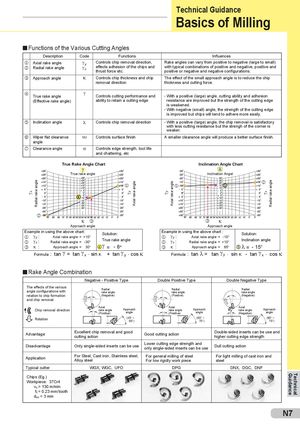
Technical Guidance Basics of Milling Functions of the Various Cutting Angles Description Code Functions Influences j Axial rake angle γy Controls chip removal direction, Rake angles can vary from positive to negative (large to small) k Radial rake angle γx effects adhesion of the chips and with typical combinations of positive and negative, positive and thrust force etc. positive or negative and negative configurations. l Approach angle κ Controls chip thickness and chip The effect of the small approach angle is to reduce the chip removal direction thickness and cutting force. m γ True rake angle Controls cutting performance and - With a positive (large) angle, cutting ability and adhesion (Effective rake angle) ability to retain a cutting edge resistance are improved but the strength of the cutting edge is weakened. - With negative (small) angle, the strength of the cutting edge is improved but chips will tend to adhere more easily. n Inclination angle λ Controls chip removal direction - With a positive (large) angle, the chip removal is satisfactory with less cutting resistance but the strengh of the corner is weaker. o Wiper flat clearance αf Controls surface finish A smaller clearance angle will produce a better surface finish. angle p Clearance angle α Controls edge strength, tool life and chattering, etc True Rake Angle Chart Inclination Angle Chart γ λ True rake angle Inclination Angel Radial rake angle Radial rake angle k Axial rake angle Axial rake angle j j n γx γy γy γx m k κ l l κ Approach angle Approach angle Example in using the above chart: Example in using the above chart : Solution: Solution: j γy : Axial rake angle = +10° True rake angle j γy : Axial rake angle = -10° Inclination angle k γx : Radial rake angle = -30° k γx : Radial rake angle = +10° l κ : Approach angle = 30° m γ = - 8o l κ : Approach angle = 65° n λ = - 15° Formula : tan γ = tan γ x . sin κ + tan γ y . cos κ Formula : tan λ = tan γ y . sin κ - tan γ x . cos κ Rake Angle Combination Negative - Positive Type Double Positive Type Double Negative Type The effects of the various Radial Radial Radial angle configurations with rake angle rake angle rake angle relation to chip formation (Negative) (Positive) (Negative) and chip removal. Axial Axial Axial Chip removal direction rake angle Approach rake angle Approach rake angle Approach (Positive) angle (Positive) angle (Negative) angle Rotation (45° ~ (60° ~ (60° ~ 60°) 75°) 75°) Excellent chip removal and good Double-sided inserts can be use and Advantage Good cutting action cutting action higher cutting edge strength Lower cutting edge strength and Disadvantage Only single-sided inserts can be use Dull cutting action only single-sided inserts can be use For Steel, Cast iron, Stainless steel, For general milling of steel For light milling of cast iron and Application Alloy steel For low rigidly work piece steel Typical cutter WGX, WGC, UFO DPG DNX, DGC, DNF Technical Guidance Chips (Eg.) Workpiece: 37Cr4 v c = 130 m/min f t = 0.23 mm/tooth doc = 3 mm N7