Общий каталог PRECITOOL - страница 460
Навигация
Quality Wins.
ARE YOU READY FOR
GENERATION EFFICIENCY?
Are you saving costs at the right place?
For machining efficiently all potentials for savings must be exploited.
But where are these potentials?
Roughly, the costs of a work piece are composed as following:
| Machine costs with operator | |
| (machining time and idle time) | approx. 50 % |
| General costs | approx. 30 % |
| Raw material | approx. 15 % |
| Tooling | approx. 4 % |
| Tool holder | approx. 1 % |
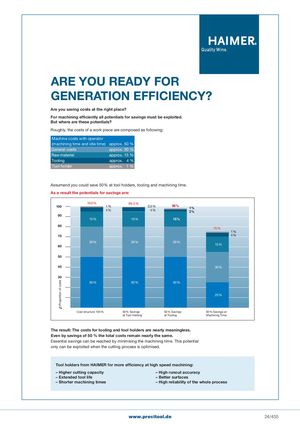
Assumend you could save 50% at tool holders, tooling and machining time.
As a result the potentials for savings are: 100% 99,5%
| 100 | 1% | 0,5% | 98 % | |
| 4% | 4% | 1 % | ||
| 2 % | ||||
| 90 |
| 15% | 15% | 15 % | ||
| 80 | ||||
| 75% | ||||
| 1% | ||||
| 70 | 4% | |||
| 30% | 30% | 30% |
60 15%
50 40 30% 30
50% 50% 50%
25%
| Cost structure 100% | 50% Savings | 50% Savings | 50% Savings at |
| at Tool Holding | at Tooling | Machining Time |
The result: The costs for tooling and tool holders are nearly meaningless. Even by savings of 50 % the total costs remain nearly the same.
Essential savings can be reached by minimising the machining time. This potential
only can be exploited when the cutting process is optimised.
Tool holders from HAIMER for more efficiency at high speed machining: