Каталог Iscar вращающийся инструмент 2017 - страница 694
Навигация
 Каталог Iscar токарные пластины ISO 2022
 Каталог Iscar инструмент для фрезерования
 Каталог Iscar решения для глубокого сверления
 Каталог Iscar полирующие фрезы
 Каталог Iscar новые продукты 2018
 Каталог Iscar концевые фрезы со сменными пластинами 2022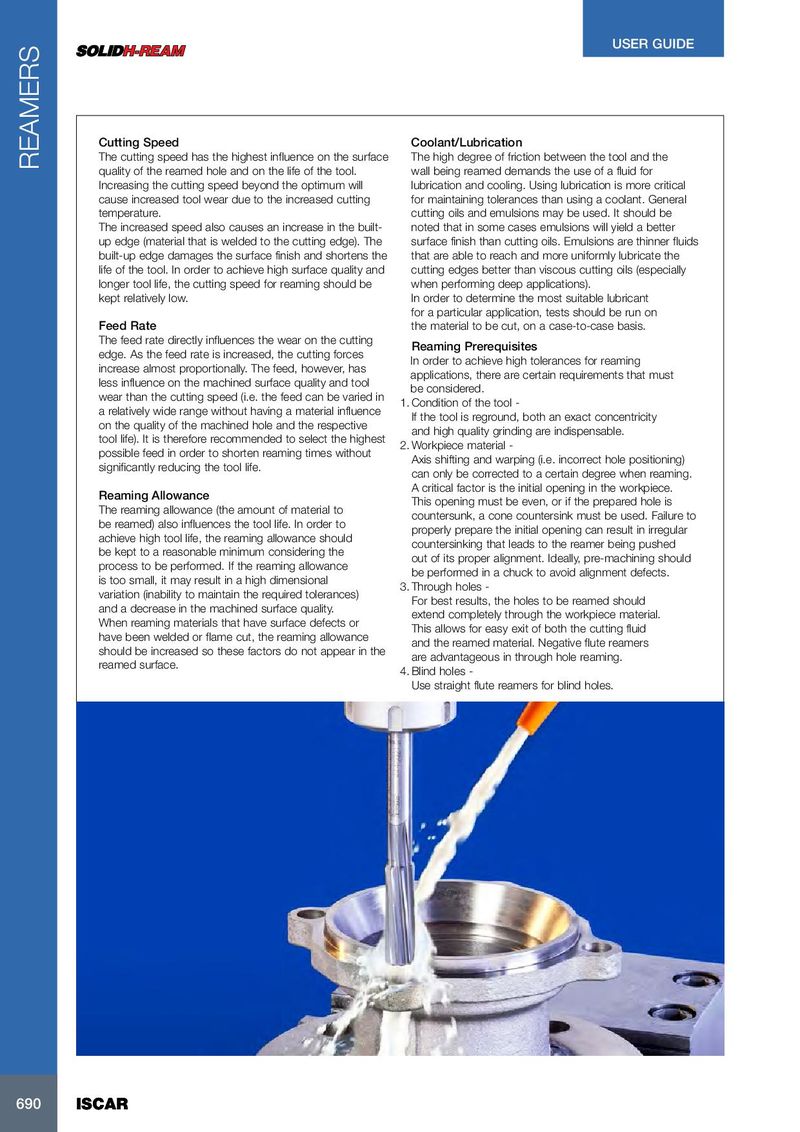
USER GUIDE Cutting Speed Coolant/Lubrication The cutting speed has the highest influence on the surface The high degree of friction between the tool and the REAMERS quality of the reamed hole and on the life of the tool. wall being reamed demands the use of a fluid for Increasing the cutting speed beyond the optimum will lubrication and cooling. Using lubrication is more critical cause increased tool wear due to the increased cutting for maintaining tolerances than using a coolant. General temperature. cutting oils and emulsions may be used. It should be The increased speed also causes an increase in the built- noted that in some cases emulsions will yield a better up edge (material that is welded to the cutting edge). The surface finish than cutting oils. Emulsions are thinner fluids built-up edge damages the surface finish and shortens the that are able to reach and more uniformly lubricate the life of the tool. In order to achieve high surface quality and cutting edges better than viscous cutting oils (especially longer tool life, the cutting speed for reaming should be when performing deep applications). kept relatively low. In order to determine the most suitable lubricant for a particular application, tests should be run on Feed Rate the material to be cut, on a case-to-case basis. The feed rate directly influences the wear on the cutting Reaming Prerequisites edge. As the feed rate is increased, the cutting forces In order to achieve high tolerances for reaming increase almost proportionally. The feed, however, has applications, there are certain requirements that must less influence on the machined surface quality and tool be considered. wear than the cutting speed (i.e. the feed can be varied in 1. Condition of the tool - a relatively wide range without having a material influence If the tool is reground, both an exact concentricity on the quality of the machined hole and the respective and high quality grinding are indispensable. tool life). It is therefore recommended to select the highest 2. Workpiece material - possible feed in order to shorten reaming times without Axis shifting and warping (i.e. incorrect hole positioning) significantly reducing the tool life. can only be corrected to a certain degree when reaming. A critical factor is the initial opening in the workpiece. Reaming Allowance This opening must be even, or if the prepared hole is The reaming allowance (the amount of material to countersunk, a cone countersink must be used. Failure to be reamed) also influences the tool life. In order to properly prepare the initial opening can result in irregular achieve high tool life, the reaming allowance should countersinking that leads to the reamer being pushed be kept to a reasonable minimum considering the out of its proper alignment. Ideally, pre-machining should process to be performed. If the reaming allowance be performed in a chuck to avoid alignment defects. is too small, it may result in a high dimensional 3. Through holes - variation (inability to maintain the required tolerances) For best results, the holes to be reamed should and a decrease in the machined surface quality. extend completely through the workpiece material. When reaming materials that have surface defects or This allows for easy exit of both the cutting fluid have been welded or flame cut, the reaming allowance and the reamed material. Negative flute reamers should be increased so these factors do not appear in the are advantageous in through hole reaming. reamed surface. 4. Blind holes - Use straight flute reamers for blind holes. 690 690 ISCAR ISCAR