Каталог Iscar вращающийся инструмент 2017 - страница 595
Навигация
 Каталог Iscar токарные пластины ISO 2022
 Каталог Iscar инструмент для фрезерования
 Каталог Iscar решения для глубокого сверления
 Каталог Iscar полирующие фрезы
 Новые режущие инструменты Iscar 2026
 Каталог Iscar новые продукты 2018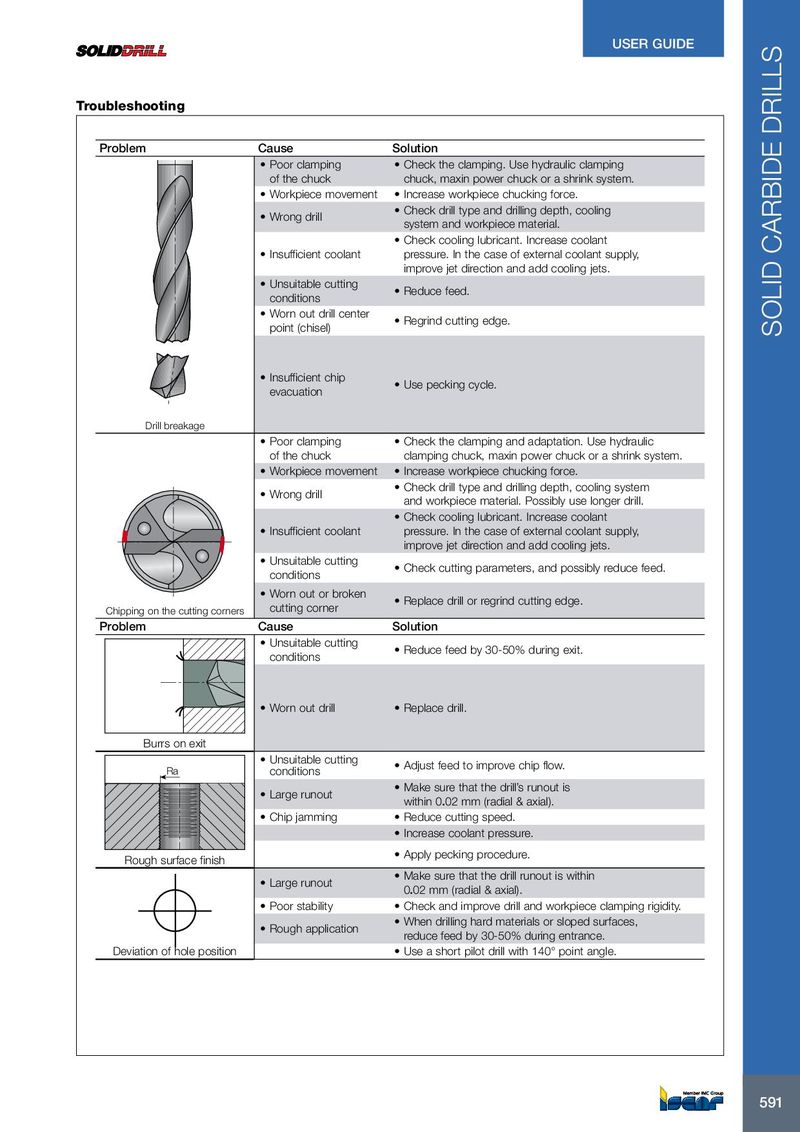
Troubleshooting
Problem Cause
- Poor clamping of the chuck
- Workpiece movement
- Wrong drill
- Insufficient coolant
- Unsuitable cutting conditions
- Worn out drill center point (chisel)
Solution
- Check the clamping. Use hydraulic clamping chuck, maxin power chuck or a shrink system.
- Increase workpiece chucking force.
- Check drill type and drilling depth, cooling system and workpiece material.
- Check cooling lubricant. Increase coolant pressure. In the case of external coolant supply, improve jet direction and add cooling jets.
- Reduce feed.
- Regrind cutting edge.
- Insufficient chip evacuation
Drill breakage
- Poor clamping of the chuck
- Workpiece movement
- Wrong drill
- Insufficient coolant
- Unsuitable cutting conditions
- Worn out or broken
Chipping on the cutting corners cutting corner Problem Cause
- Unsuitable cutting conditions
- Use pecking cycle.
- Check the clamping and adaptation. Use hydraulic clamping chuck, maxin power chuck or a shrink system.
- Increase workpiece chucking force.
- Check drill type and drilling depth, cooling system and workpiece material. Possibly use longer drill.
- Check cooling lubricant. Increase coolant pressure. In the case of external coolant supply, improve jet direction and add cooling jets.
- Check cutting parameters, and possibly reduce feed.
- Replace drill or regrind cutting edge.
Solution
- Reduce feed by 30-50% during exit.
- Worn out drill
Burrs on exit
- Unsuitable cutting
Ra conditions
- Large runout
- Chip jamming
Rough surface finish
- Large runout
- Poor stability
- Rough application
Deviation of hole position
- Replace drill.
- Adjust feed to improve chip flow.
- Make sure that the drill’s runout is within 0.02 mm (radial & axial).
- Reduce cutting speed.
- Increase coolant pressure.
- Apply pecking procedure.
- Make sure that the drill runout is within 0.02 mm (radial & axial).
- Check and improve drill and workpiece clamping rigidity.
- When drilling hard materials or sloped surfaces, reduce feed by 30-50% during entrance.
- Use a short pilot drill with 140° point angle.