Каталог Iscar вращающийся инструмент 2017 - страница 505
Навигация
 Каталог Iscar токарные пластины ISO 2022
 Каталог Iscar инструмент для фрезерования
 Каталог Iscar решения для глубокого сверления
 Каталог Iscar полирующие фрезы
 Новые режущие инструменты Iscar 2026
 Каталог Iscar новые продукты 2018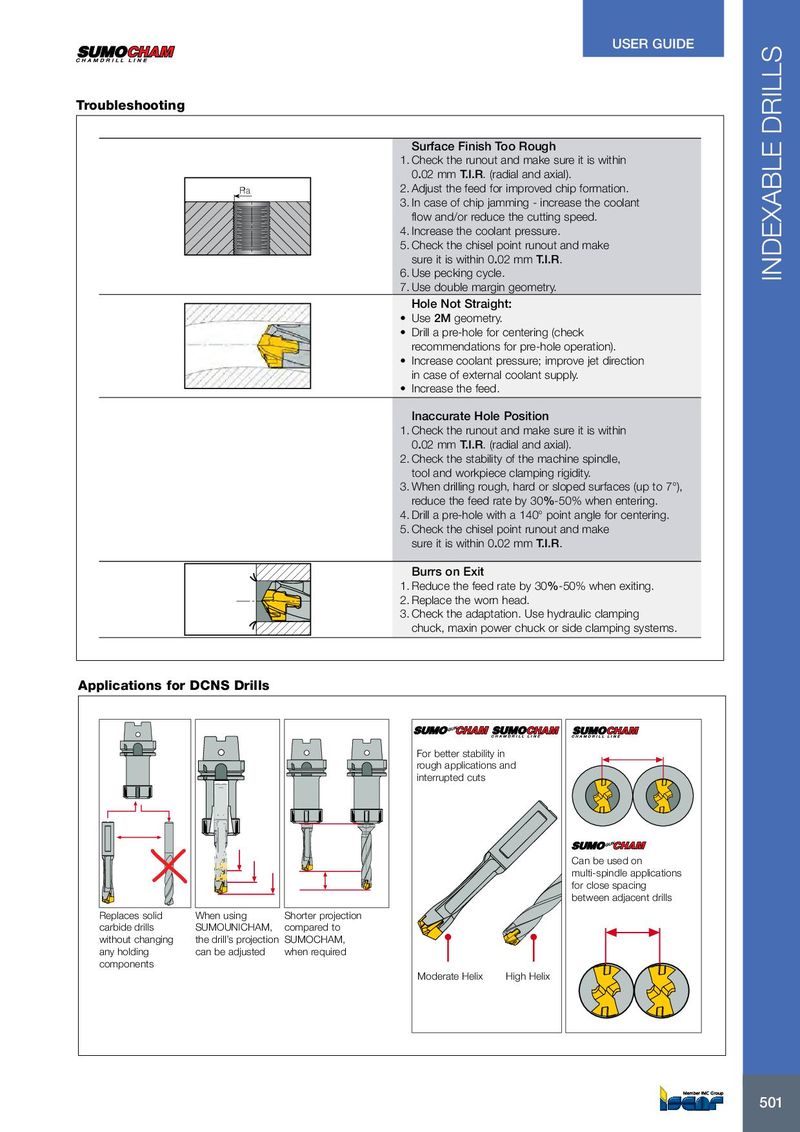
USER GUIDE INDEXABLE DRILLS Troubleshooting Surface Finish Too Rough 1. Check the runout and make sure it is within 0.02 mm T.I.R. (radial and axial). Ra 2. Adjust the feed for improved chip formation. 3. In case of chip jamming - increase the coolant flow and/or reduce the cutting speed. 4. Increase the coolant pressure. 5. Check the chisel point runout and make sure it is within 0.02 mm T.I.R. 6. Use pecking cycle. 7. Use double margin geometry. Hole Not Straight: • Use 2M geometry. • Drill a pre-hole for centering (check recommendations for pre-hole operation). • Increase coolant pressure; improve jet direction in case of external coolant supply. • Increase the feed. Inaccurate Hole Position 1. Check the runout and make sure it is within 0.02 mm T.I.R. (radial and axial). 2. Check the stability of the machine spindle, tool and workpiece clamping rigidity. 3. When drilling rough, hard or sloped surfaces (up to 7°), reduce the feed rate by 30%-50% when entering. 4. Drill a pre-hole with a 140° point angle for centering. 5. Check the chisel point runout and make sure it is within 0.02 mm T.I.R. Burrs on Exit 1. Reduce the feed rate by 30%-50% when exiting. 2. Replace the worn head. 3. Check the adaptation. Use hydraulic clamping chuck, maxin power chuck or side clamping systems. Applications for DCNS Drills For better stability in rough applications and interrupted cuts Can be used on multi-spindle applications for close spacing between adjacent drills Replaces solid When using Shorter projection carbide drills SUMOUNICHAM, compared to without changing the drill’s projection SUMOCHAM, any holding can be adjusted when required components Moderate Helix High Helix 501