Каталог Iscar вращающийся инструмент 2017 - страница 504
Навигация
 Каталог Iscar токарные пластины ISO 2022
 Каталог Iscar инструмент для фрезерования
 Каталог Iscar решения для глубокого сверления
 Каталог Iscar полирующие фрезы
 Новые режущие инструменты Iscar 2026
 Каталог Iscar новые продукты 2018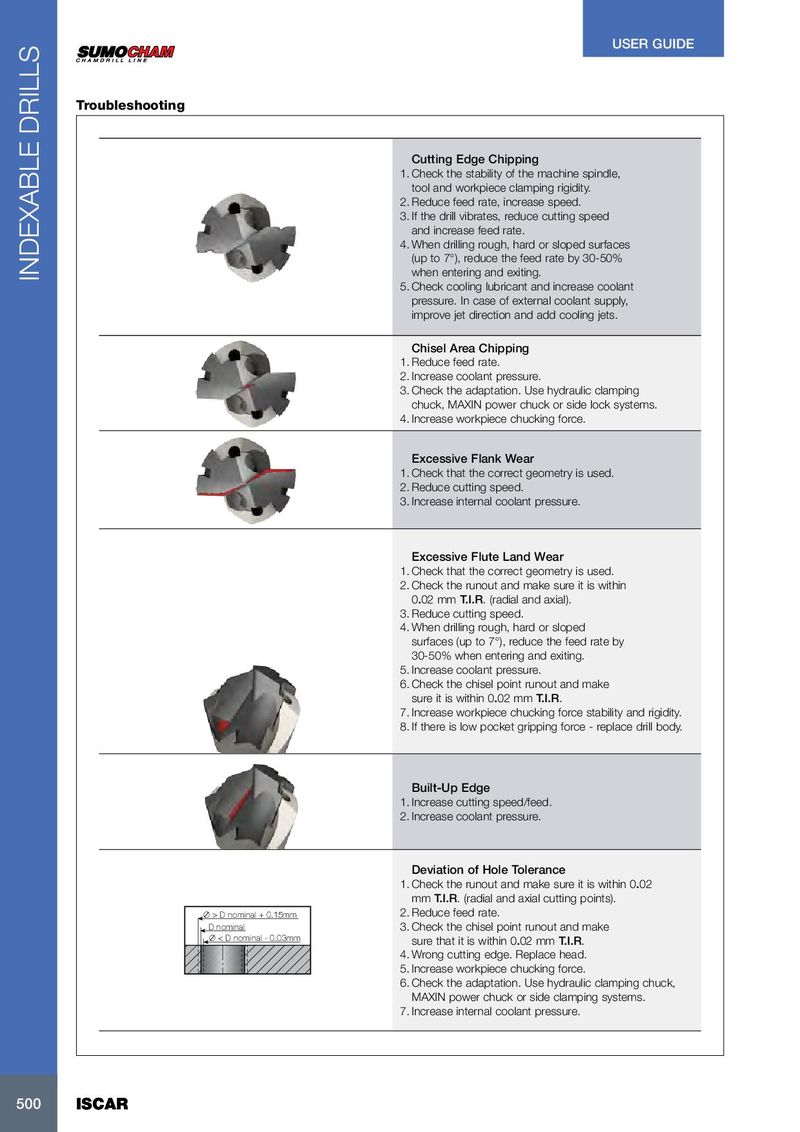
USER GUIDE INDEXABLE DRILLS Troubleshooting Cutting Edge Chipping 1. Check the stability of the machine spindle, tool and workpiece clamping rigidity. 2. Reduce feed rate, increase speed. 3. If the drill vibrates, reduce cutting speed and increase feed rate. 4. When drilling rough, hard or sloped surfaces (up to 7°), reduce the feed rate by 30-50% when entering and exiting. 5. Check cooling lubricant and increase coolant pressure. In case of external coolant supply, improve jet direction and add cooling jets. Chisel Area Chipping 1. Reduce feed rate. 2. Increase coolant pressure. 3. Check the adaptation. Use hydraulic clamping chuck, MAXIN power chuck or side lock systems. 4. Increase workpiece chucking force. Excessive Flank Wear 1. Check that the correct geometry is used. 2. Reduce cutting speed. 3. Increase internal coolant pressure. Excessive Flute Land Wear 1. Check that the correct geometry is used. 2. Check the runout and make sure it is within 0.02 mm T.I.R. (radial and axial). 3. Reduce cutting speed. 4. When drilling rough, hard or sloped surfaces (up to 7°), reduce the feed rate by 30-50% when entering and exiting. 5. Increase coolant pressure. 6. Check the chisel point runout and make sure it is within 0.02 mm T.I.R. 7. Increase workpiece chucking force stability and rigidity. 8. If there is low pocket gripping force - replace drill body. Built-Up Edge 1. Increase cutting speed/feed. 2. Increase coolant pressure. Deviation of Hole Tolerance 1. Check the runout and make sure it is within 0.02 mm T.I.R. (radial and axial cutting points). Ø > D nominal + 0.15mm 2. Reduce feed rate. D nominal 3. Check the chisel point runout and make Ø < D nominal - 0.03mm sure that it is within 0.02 mm T.I.R. 4. Wrong cutting edge. Replace head. 5. Increase workpiece chucking force. 6. Check the adaptation. Use hydraulic clamping chuck, MAXIN power chuck or side clamping systems. 7. Increase internal coolant pressure. 500 ISCAR