Каталог Iscar вращающийся инструмент 2017 - страница 280
Навигация
 Каталог Iscar токарные пластины ISO 2022
 Каталог Iscar инструмент для фрезерования
 Каталог Iscar решения для глубокого сверления
 Каталог Iscar полирующие фрезы
 Новые режущие инструменты Iscar 2026
 Каталог Iscar новые продукты 2018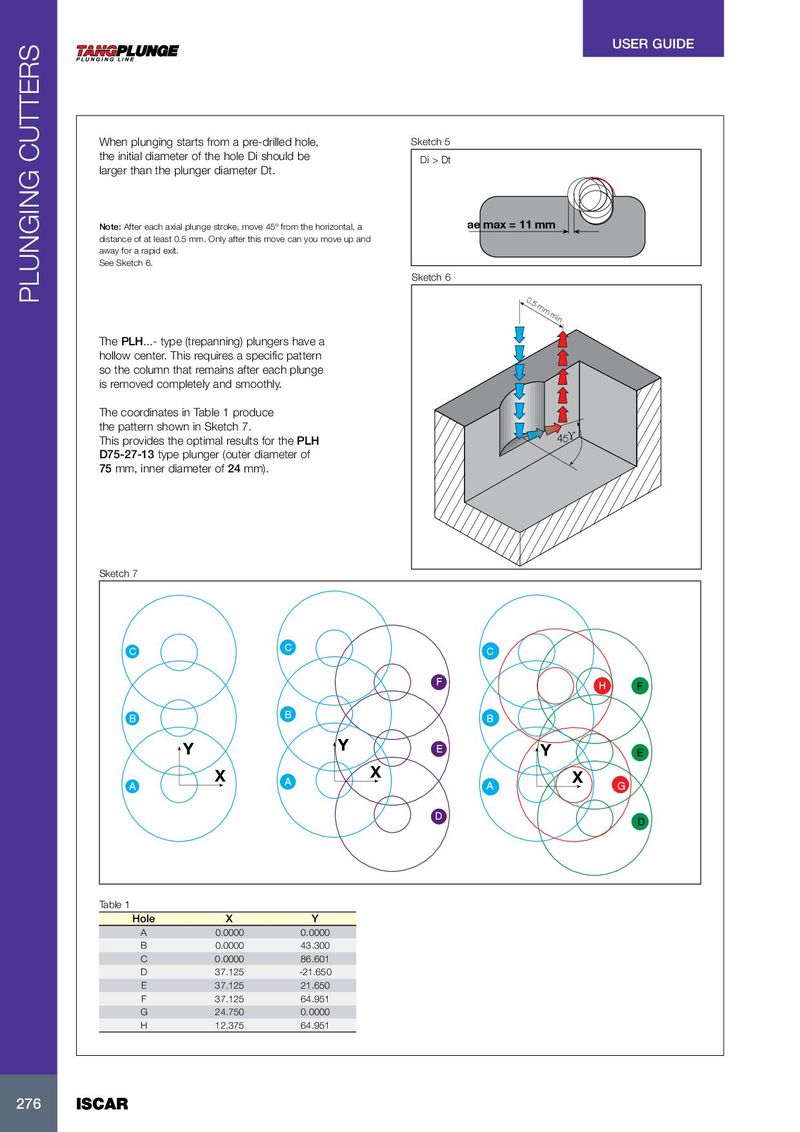
When plunging starts from a pre-drilled hole, the initial diameter of the hole Di should be larger than the plunger diameter Dt.
Note: After each axial plunge stroke, move 45º from the horizontal, a distance of at least 0.5 mm. Only after this move can you move up and away for a rapid exit. See Sketch 6.
The PLH...- type (trepanning) plungers have a hollow center. This requires a specific pattern so the column that remains after each plunge is removed completely and smoothly. The coordinates in Table 1 produce the pattern shown in Sketch 7. This provides the optimal results for the PLH D75-27-13 type plunger (outer diameter of 75 mm, inner diameter of 24 mm).
Sketch 5 Di > Dt Di Dt
ae max = 11 mm
Sketch 6 0.5 mm min
45ϒ
Sketch 7
C C C
F H F
B B B
| Y | Y | Y | ||
| E | E |
X X X
A A A G
D D
Table 1
| Hole | X | Y |
| A | 0.0000 | 0.0000 |
| B | 0.0000 | 43.300 |
| C | 0.0000 | 86.601 |
| D | 37.125 | -21.650 |
| E | 37.125 | 21.650 |
| F | 37.125 | 64.951 |
| G | 24.750 | 0.0000 |
| H | 12.375 | 64.951 |