Каталог Iscar токарный инструмент 2017 - страница 422
Навигация
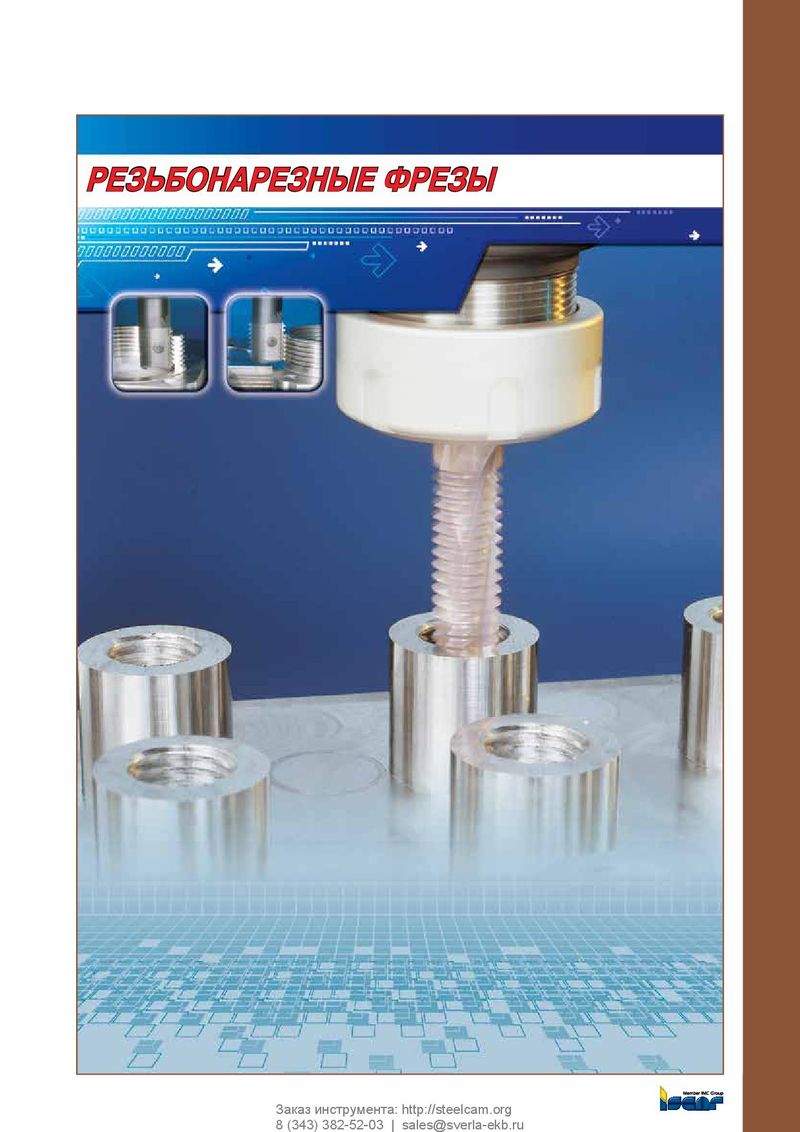 Каталог Iscar резьбонарезные фрезы
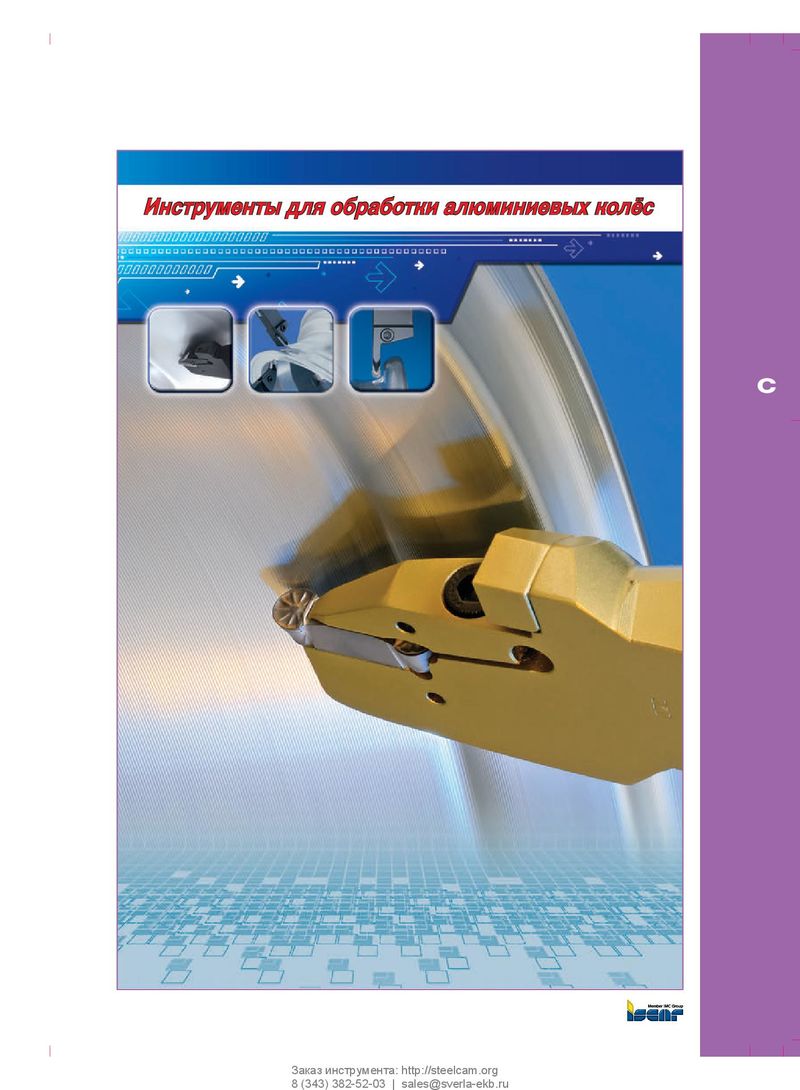 Каталог Iscar инструмент для обработки алюминиевых колёс
 Каталог Iscar державки и пластины для нарезания резьбы 2022
 Каталог Iscar расточные системы 2022
 Каталог Iscar высокоточные развертки и метчики 2022
 Токарные инструменты Iscar (часть 2) 2026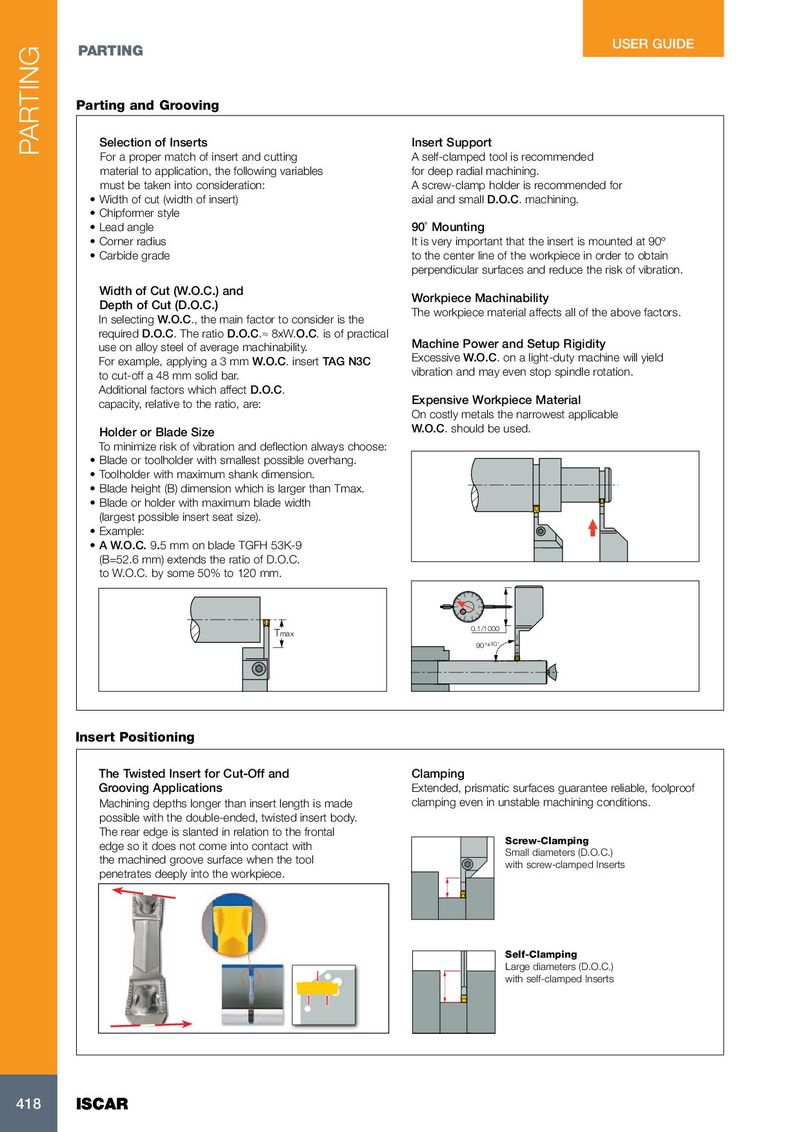
Parting and Grooving
Selection of Inserts Insert Support For a proper match of insert and cutting A self-clamped tool is recommended material to application, the following variables for deep radial machining. must be taken into consideration: A screw-clamp holder is recommended for
- Width of cut (width of insert) axial and small D.O.C. machining.
- Chipformer style
- Lead angle 90˚ Mounting
- Corner radius It is very important that the insert is mounted at 90º
- Carbide grade to the center line of the workpiece in order to obtain
perpendicular surfaces and reduce the risk of vibration. Width of Cut (W.O.C.) and Workpiece Machinability Depth of Cut (D.O.C.) The workpiece material affects all of the above factors. In selecting W.O.C., the main factor to consider is the required D.O.C. The ratio D.O.C.≈ 8xW.O.C. is of practical use on alloy steel of average machinability. Machine Power and Setup Rigidity For example, applying a 3 mm W.O.C. insert TAG N3C Excessive W.O.C. on a light-duty machine will yield to cut-off a 48 mm solid bar. vibration and may even stop spindle rotation. Additional factors which affect D.O.C. capacity, relative to the ratio, are: Expensive Workpiece Material On costly metals the narrowest applicable Holder or Blade Size W.O.C. should be used. To minimize risk of vibration and deflection always choose:
- Blade or toolholder with smallest possible overhang.
- Toolholder with maximum shank dimension.
- Blade height (B) dimension which is larger than Tmax.
- Blade or holder with maximum blade width (largest possible insert seat size).
- Example:
- A W.O.C. 9.5 mm on blade TGFH 53K-9 (B=52.6 mm) extends the ratio of D.O.C. to W.O.C. by some 50% to 120 mm.
T 0.1/1000 max 90°±10'
Insert Positioning
The Twisted Insert for Cut-Off and Clamping Grooving Applications Extended, prismatic surfaces guarantee reliable, foolproof Machining depths longer than insert length is made clamping even in unstable machining conditions. possible with the double-ended, twisted insert body. The rear edge is slanted in relation to the frontal edge so it does not come into contact with Screw-Clamping Small diameters (D.O.C.) the machined groove surface when the tool with screw-clamped Inserts penetrates deeply into the workpiece.
Self-Clamping Large diameters (D.O.C.) with self-clamped Inserts