Средства индивидуальной защиты Hoffmann Group 2026 - страница 492
Навигация
 Новые режущие инструменты, производственная мебель и средства защиты Hoffmann Group 2027
 Каталог Hoffmann Group запасные части, оснастка и СИЗ
 Каталог Hoffmann Group ручной и измерительный инструмент
 Каталог Hoffmann Group режущий и вспомогательный инструмент
 Производственная мебель и системы хранения Hoffmann Group 2026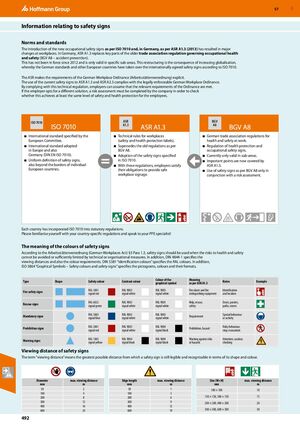
Информация, относящаяся к знакам безопасности
Нормы и стандарты
Введение новых знаков безопасности на производстве согласно ISO 7010 и в Германии согласно ASR A1.3 (2013) привело к серьёзным изменениям на рабочих местах. В Германии ASR A1.3 заменяет ключевые части более старого положения об охране труда объединения (BGV A8 – предотвращение несчастных случаев).
Это не действует с 2012 года и действительно только в отдельных областях. Эта реструктуризация является следствием растущей глобализации, при которой германские стандарты и другие европейские страны приняли международно согласованные знаки безопасности согласно ISO 7010. ASR конкретизирует требования Немецкого постановления об условиях труда (Arbeitsstättenverordnung).
Использование текущих знаков безопасности согласно ASR A1.3 и ASR A2.3 соответствует юридически обязательному Немецкому постановлению об условиях труда. Соблюдая этот технический регламент, работодатели могут предположить, что выполнены соответствующие требования постановления.
Если работодатель выбирает иное решение, компания должна провести оценку риска, чтобы проверить, обеспечивает ли это как минимум такой же уровень безопасности и защиты здоровья сотрудников.
| ISO 7010 | ASR A1.3 | BGV A8 |
|---|---|---|
| Международный стандарт, установленный Европейским комитетом. | Технические правила для рабочих мест (разметка безопасности и здоровья). | Немецкие положения профессиональных объединений об охране труда. |
| Международный стандарт, принятый в Европе и также в Германии (DIN EN ISO 7010). | Заменяет старые положения согласно BGV A8. | Положение об охране здоровья и знаки безопасности на производстве. |
| Единое определение знаков безопасности также за границами отдельных европейских стран. | Принятие знаков безопасности, установленных в ISO 7010. | В настоящее время действительно только в отдельных областях. |
| С этими положениями работодатели выполняют свои обязательства по обеспечению безопасной разметки на рабочем месте. | Использование знаков безопасности согласно BGV A8 только в сочетании с оценкой риска. |
Каждая страна включила ISO 7010 в своё национальное законодательство. Пожалуйста, ознакомьтесь с действующими в вашей стране нормативами и обратитесь к специалисту по средствам защиты!
Значение цветов знаков безопасности
Согласно Постановлению об условиях труда (Arbeitsstättenverordnung) (немецкое Постановление об условиях труда) §3 пункт 1.3, знаки безопасности следует использовать, когда риски для здоровья и безопасности не могут быть избежаны или достаточно ограничены техническими или организационными мерами. Кроме того, DIN 4844-1 определяет расстояния видимости и требования к цвету. DIN 5381 «Идентификационные цвета» указывает цвета RAL. Кроме того, ISO 3864 «Графические символы – цвета безопасности и знаки безопасности» определяет пиктограммы, цвета и их форматы.
| Тип | Форма | Цвет безопасности (RAL) | Контрастный цвет | Цвет графического символа | Значение согласно ASR A1.3 | Примечания |
|---|---|---|---|---|---|---|
| Знаки пожарной безопасности | Квадрат | RAL 3001 сигнальный красный | RAL 9003 сигнальный белый | RAL 9003 сигнальный белый | Пожарная тревога и оборудование для тушения пожара | Идентификация и локация |
| Спасательные знаки | Прямоугольник | RAL 6032 сигнальный зелёный | RAL 9003 сигнальный белый | RAL 9003 сигнальный белый | Помощь, спасение, безопасность | Двери, плакаты, пути, комнаты |
| Обязательные знаки | Круг | RAL 5005 сигнальный синий | RAL 9003 сигнальный белый | RAL 9003 сигнальный белый | Требование специального поведения или деятельности | Особое поведение или деятельность |
| Запрещающие знаки | Круг | RAL 3001 сигнальный красный | RAL 9003 сигнальный белый | RAL 9004 сигнальный чёрный | Запрет, опасность, остановка, эвакуация | Опасное поведение, остановка, эвакуация |
| Предупреждающие знаки | Треугольник | RAL 1003 сигнальный жёлтый | RAL 9004 сигнальный чёрный | RAL 9004 сигнальный чёрный | Предупреждение об опасностях или рисках | Внимание, осторожность, проверка |
Расстояние видимости знаков безопасности
Термин «расстояние видимости» означает максимальное расстояние, с которого знак безопасности по-прежнему читаем и узнаваем с точки зрения его формы и цвета.
| Круглые знаки | Квадратные/прямоугольные знаки | Прямоугольные знаки | |||
|---|---|---|---|---|---|
| Диаметр (мм) | Макс. расстояние видимости (м) | Длина края (мм) | Макс. расстояние видимости (м) | Размер Ш×В (мм) | Макс. расстояние видимости (м) |
| 50 | 2 | 50 | 1 | 100 × 100 | 10 |
| 100 | 4 | 100 | 3 | 150 × 150, 300 × 150 | 15 |
| 200 | 8 | 200 | 6 | 200 × 200, 400 × 200 | 20 |
| 300 | 12 | 300 | 9 | 300 × 300, 600 × 300 | 30 |
| 400 | 16 | 400 | 12 | ||
| 600 | 24 | 600 | 19 | ||