Средства индивидуальной защиты Hoffmann Group 2026 - страница 172
Навигация
 Новые режущие инструменты, производственная мебель и средства защиты Hoffmann Group 2027
 Каталог Hoffmann Group запасные части, оснастка и СИЗ
 Каталог Hoffmann Group ручной и измерительный инструмент
 Каталог Hoffmann Group режущий и вспомогательный инструмент
 Производственная мебель и системы хранения Hoffmann Group 2026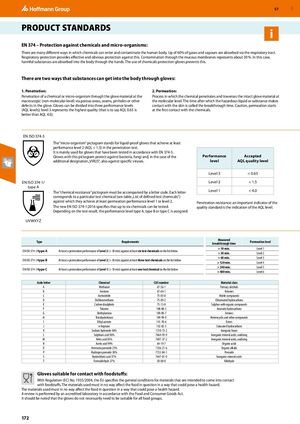
Стандарты изделий
EN 374 – защита от химических веществ и микроорганизмов:
Химические вещества могут попасть в организм человека и загрязнить его множеством различных способов. До 60% газов и паров абсорбируются через дыхательные пути. Дыхательная защита обеспечивает эффективную и очевидную защиту от этого. Загрязнение через слизистые оболочки составляет около 30%. В этом случае вредные вещества абсорбируются в организм через руки. Использование перчаток для защиты от химических веществ предотвращает это.
Вещества могут попасть в организм через перчатки двумя способами:
1. Проникновение:
Проникновение химического вещества или микроорганизма через материал перчатки на макроскопическом (немолекулярном) уровне через пористые области, швы, микроотверстия или другие дефекты перчатки. Перчатки можно разделить на три уровня производительности (уровни AQL); уровень 3 представляет наивысшее качество (то есть AQL 0,65 лучше, чем AQL 4,0).
2. Проницаемость:
Процесс, при котором химическое вещество проникает и проходит через неповреждённый материал перчатки на молекулярном уровне. Время, в течение которого опасная жидкость или вещество вступает в контакт с кожей, называется временем прорыва. Внимание: проницаемость начинается при первом контакте с химическими веществами.
EN ISO 374-5
Пиктограмм «микроорганизм» обозначает непроницаемые для жидкостей перчатки, которые достигают по крайней мере уровня производительности 2 (AQL < 1,5) при испытании на проникновение. Он в основном используется для перчаток, протестированных в соответствии с EN 374-5. Перчатки с данным пиктограммом защищают от бактерий, грибков и, в случае дополнительного обозначения «ВИРУС», также от определённых вирусов.
| Уровень производительности | Принятый уровень качества AQL |
|---|---|
| Уровень 3 | < 0,65 |
| Уровень 2 | < 1,5 |
| Уровень 1 | < 4,0 |
EN ISO 374-1 / тип A
Пиктограмм «устойчивость к химическим веществам» должен сопровождаться буквенным кодом. Каждая буква соответствует определённому испытуемому химическому веществу (см. таблицу «Список определённых испытуемых химических веществ»), против которого они достигают по крайней мере уровня производительности проницаемости 1 или уровня 2. Новый EN ISO 374-1:2016 предусматривает, что можно испытывать до шести химических веществ. В зависимости от результата испытания назначается тип производительности A, тип B или тип C.
| Тип | Требования | Измеренное время прорыва | Уровень проницаемости |
|---|---|---|---|
| EN ISO 374-1/тип A | По крайней мере уровень производительности проницаемости 2 (> 30 мин) против по крайней мере шести испытуемых химических веществ из списка | > 10 мин. | Уровень 1 |
| > 30 мин. | Уровень 2 | ||
| > 60 мин. | Уровень 3 | ||
| > 120 мин. | Уровень 4 | ||
| > 240 мин. | Уровень 5 | ||
| > 480 мин. | Уровень 6 | ||
| EN ISO 374-1/тип B | По крайней мере уровень производительности проницаемости 2 (> 30 мин) против по крайней мере трёх испытуемых химических веществ из списка | ||
| EN ISO 374-1/тип C | По крайней мере уровень производительности проницаемости 1 (> 10 мин) против по крайней мере одного испытуемого химического вещества из списка | ||
Стойкость к проникновению – важный показатель стандарта качества является указание уровня AQL.
| Буквенный код | Химическое вещество | Номер CAS | Класс материала |
|---|---|---|---|
| A | Метанол | 67-56-1 | Первичные спирты |
| B | Ацетон | 67-64-1 | Кетоны |
| C | Ацетонитрил | 75-05-8 | Нитриловые соединения |
| D | Дихлорметан | 75-09-2 | Хлорированные углеводороды |
| E | Сероуглерод | 75-15-0 | Сера с органическими соединениями |
| F | Толуол | 108-88-3 | Ароматические углеводороды |
| G | Диэтиламин | 109-89-7 | Амины |
| H | Тетрагидрофуран | 109-99-9 | Гетероциклические и прочие соединения |
| I | Этилацетат | 141-78-6 | Эфиры |
| J | н-гептан | 142-82-5 | Насыщенные углеводороды |
| K | Гидроксид натрия 40% | 1310-73-2 | Неорганические основания |
| L | Серная кислота 96% | 7664-93-9 | Неорганические минеральные кислоты, окисляющие |
| M | Азотная кислота 65% | 7697-37-2 | Неорганические минеральные кислоты, окисляющие |
| N | Уксусная кислота 99% | 64-19-7 | Органические кислоты |
| O | Пероксид аммиака 25% | 1336-21-6 | Органические щёлочи |
| P | Перекись водорода 30% | 7722-84-1 | Пероксиды |
| S | Соляная кислота 37% | 7647-01-0 | Неорганические минеральные кислоты |
| T | Формальдегид 37% | 50-00-0 | Альдегид |
Перчатки, пригодные для контакта с продуктами питания:
Согласно Регламенту (ЕС) № 1935/2004 ЕС устанавливает общие условия для материалов, предназначенных для контакта с продуктами питания. Используемые материалы ни в коем случае не должны воздействовать на рассматриваемый пищевой продукт таким образом, чтобы это могло создать угрозу для здоровья. Используемые материалы ни в коем случае не должны воздействовать на рассматриваемый пищевой продукт таким образом, чтобы это могло создать угрозу для здоровья. Проверка проводится аккредитованной лабораторией в соответствии с Законом о продовольствии и потребительских товарах. Следует отметить, что перчатки не обязательно должны быть пригодны для всех групп продуктов питания.