Производственная мебель и системы хранения Hoffmann Group 2026 - страница 634
Навигация
 Каталог Hoffmann Group ручной и измерительный инструмент
 Каталог Hoffmann Group режущий и вспомогательный инструмент
 Режущие и зажимные инструменты Hoffmann Group 2026
 Новые режущие инструменты, производственная мебель и средства защиты Hoffmann Group 2027
 Средства индивидуальной защиты Hoffmann Group 2026
 - Table of contents
- Transport systems
- Workstation systems
- Tool cabinets
- Cabinets, computer workstations,lockers
- GARANT GridLine accessories
- Completing the range
- GARANT Tool24 and HOLEX 24seven industrialvending solutions, CNC, ESD, office
- Environmental technology
- Storage technology, spatial systemsand containers
- Index, care instructions, overview of colours
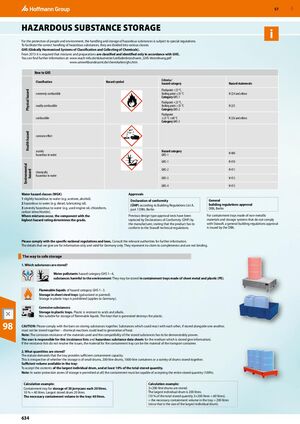
Хранение опасных веществ
Для защиты людей и окружающей среды обращение с опасными веществами и их хранение подлежат особым нормам. Для облегчения надлежащего обращения с опасными веществами они подразделяются на различные классы.
GHS (Глобальная гармонизированная система классификации и маркировки химических веществ).
С 2015 года требуется, чтобы смеси и препараты классифицировались и определялись только в соответствии с GHS.
Классификация по системе GHS
| Классификация | Символ опасности | Критерии / Класс опасности | Заявления об опасности |
|---|---|---|---|
| Физическая опасность | |||
| Чрезвычайно легковоспламеняющийся | Температура вспышки <23 °C, температура кипения ≤35 °C, категория GHS-1 | H 224 и др. | |
| Легковоспламеняющийся | Температура вспышки <23 °C, температура кипения >35 °C, категория GHS-2 | H 225 | |
| Горючий | Температура вспышки ≥23 °C ≤60 °C, категория GHS-3 | H 226 и др. | |
| Опасность для здоровья | |||
| Коррозионное действие | |||
| Экологическая опасность | |||
| Острая опасность для водных организмов | Класс опасности GHS-1 | H 400 | |
| GHS-1 | H 410 | ||
| Хроническая опасность для водных организмов | GHS-2 | H 411 | |
| GHS-3 | H 412 | ||
| GHS-4 | H 413 | ||
Классы опасности для водных ресурсов (WGK)
- Класс 1 — незначительно опасны для водных ресурсов (например, ацетон, спирт).
- Класс 2 — опасны для водных ресурсов (например, дизельное топливо, смазочное масло).
- Класс 3 — чрезвычайно опасны для водных ресурсов (например, отработанное масло, хлороформ, четыреххлористый углерод).
При наличии смесей компонент с наивысшей степенью опасности определяет класс.
Одобрения
Общие: Предыдущие испытания на соответствие типу конструкции заменены на Декларации соответствия (ÜHP) производителя, которые подтверждают, что продукт должен соответствовать техническим нормам StawaR. Для поддонов из неметаллических материалов и систем хранения, которые не соответствуют StawaR, общее одобрение строительных норм выдается компанией DIBt, Berlin.
Путь к безопасному хранению
1. Какие вещества хранятся?
- Загрязняющие воду жидкости категорий опасности GHS 1−4, вещества, вредные для окружающей среды: Могут храниться в поддонах из листовой стали и пластика (ПЭ).
- Легковоспламеняющиеся жидкости категорий опасности GHS 1−3. Хранение в поддонах из стальных листов (оцинкованных или окрашенных). Хранение в пластиковых поддонах запрещено (применяется в Германии).
- Коррозионные вещества: Хранение в пластиковых поддонах. Пластик устойчив к кислотам и щелочам. Не подходит для хранения легковоспламеняющихся жидкостей. Выделяющееся тепло разрушает пластик.
Внимание: Необходимо соблюдать запреты на совместное хранение веществ. Вещества, которые могут взаимодействовать друг с другом при хранении рядом, не должны храниться вместе — химические реакции могут привести к выделению тепла. Химическая стойкость используемых материалов и совместимость хранимых веществ должны быть доказаны. За это отвечает пользователь (информацию дают списки стойкости и технические листы опасных веществ). Если списки стойкости не решают проблему, материал поддона может быть материалом транспортного контейнера.
2. Какие объемы хранятся?
Нормы требуют, чтобы поддон обеспечивал достаточную вместимость. Это не зависит от того, хранятся ли малые барабаны, барабаны на 200 литров, контейнеры на 1000 литров или различные барабаны вместе.
Достаточный объем, доступный в поддоне:
- Для размещения содержимого самого крупного отдельного барабана и минимум 10% от общего хранимого количества.
Примечание: В зонах защиты водных ресурсов (если хранение вообще разрешено) вместимость должна быть способна принять всё хранимое количество (100%).
Пример расчета: Поддон для хранения 20 ёмкостей по 20 литров. 10% = 40 литров. Самый крупный хранимый барабан — 20 литров. Необходимый объем вместимости поддона: 40 литров.
Пример расчета: Хранятся 3 барабана по 200 литров. Самый крупный отдельный барабан — 200 литров (10% от общего хранимого количества 3×200 литров = 60 литров). Необходимый объем вместимости поддона = 200 литров (так как это размер самого крупного отдельного барабана).