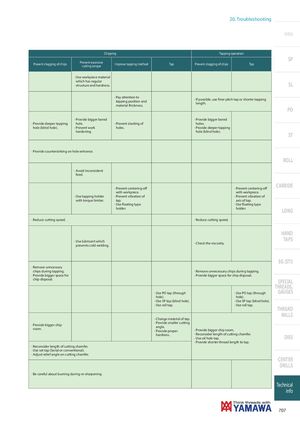
| Prevent clogging of chips | Chippi Prevent excessive cutting torque | ng Improve tapping method | Tap | Tapping o Prevent clogging of chips | peration Tap | SP |
| ∙ Use workpiece material which has regular structure and hardness. | | | | | SL |
| | ∙ Pay attention to tapping position and material thickness. | | ∙ If possible, use fi ner pitch length. | i tap or shorter tapping | PO |
| ∙ Provide deeper tapping hole (blind hole). | ∙ Provide bigger bored hole. ∙ Prevent work hardening. | ∙ Prevent slanting of holes. | | ∙ Provide bigger bored holes. ∙ Provide deeper tapping hole (blind hole). | | ST |
| ∙ Provide countersinking on | hole entrance. | | | | | ROLL |
| ∙ Avoid inconsistent feed. | | | | | |
| ∙ Use tapping holder with torque limiter. | ∙ Prevent centering-off with workpiece. ∙ Prevent vibration of tap. ∙ Use fl oating type holder. | | | ∙ Prevent centering-off with workpiece. ∙ Prevent vibration of axis of tap. ∙ Use fl oating type holder. | CARBIDE LONG |
| ∙ Reduce cutting speed. | | | | ∙ Reduce cutting speed. | | |
| ∙ Use lubricant which prevents cold welding. | | | ∙ Check the viscosity. | | HAND TAPS |
| ∙ Remove unncessary chips during tapping. ∙ Provide bigger space for chip disposal. | | | | ∙ Remove unnecessary chi ∙ Provide bigger space for | ps during tapping. chip disposal. | EG (STI) SPECIAL THREADS |
| | | ∙ Use PO tap (through hole). ∙ Use SP tap (blind hole). ∙ Use roll tap. | | ∙ Use PO tap (through hole). ∙ Use SP tap (blind hole). ∙ Use roll tap. | , GAUGES THREAD |
| ∙ Provide bigger chip room. | | | ∙ Change material of tap. ∙ Provide smaller cutting angle. ∙ Provide proper hardness. | ∙ Provide bigger chip room ∙ Reconsider length of cutt ∙ Use oil hole tap. ∙ Provide shorter thread le | . ing chamfer. ngth to tap | MILLS DIES |
| ∙ Reconsider length of cuttin ∙ Use set tap (Serial or conve ∙ Adjust relief angle on cutti | g chamfer. ntional). ng chamfer. | | | | . | CENTER |
| ∙ Be careful about burning d | uring re-sharpening | | | | | DRILLS |
 Обший каталог Yamawa 2016 - 2017
 Краткое руководство Yamawa по каталогам
 Общий каталог Yamawa 2022 - 2023
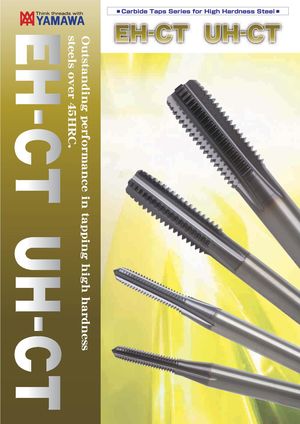 Каталоги Yamawa твердосплавные метчики для закаленной стали