Общий каталог Yamawa 2021 - страница 701
Навигация
 Обший каталог Yamawa 2016 - 2017
 Краткое руководство Yamawa по каталогам
 Общий каталог Yamawa 2022 - 2023
 Каталоги Yamawa твердосплавные метчики для закаленной стали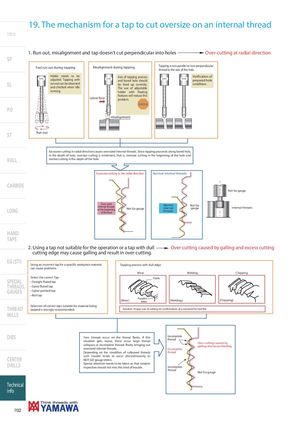
19. The mechanism for a tap to cut oversize on an internal thread
1. Run out, misalignment and tap doesn’t cut perpendicular into holes Over-cutting at radial direction
SP
| Tool run out during tapping | Misalignment during tapping | Tapping a non-parallel or non-perpendicular |
| thread to the axis of the hole. |
| Holder needs to be | Axis of tapping process | Verification of | |||||
| holder | adjusted. Tapping with | holder | and bored hole should | holder | holder | prepared hole | |
| SL | run out can be observed | be lined up correctly. | condition. |
and checked when idle The use of adjustable running. holder with floating features will reduce this Lateral force problem.
Solutions
PO
misalignment
ST Run out
Excessive cutting in radial direction causes oversized internal threads. Since tapping proceeds along bored hole, in the depth of hole, oversize cutting is minimized, that is, oversize cutting in the beginning of the hole and ROLL normal cutting in the depth of the hole.
Excessive-cutting in the radial direction Normal internal threads
CARBIDE
Not Go gauge
| Over sized | Normal | Not Go | |||
| internal threads | internal threads | ||||
| LONG | at the beginning | Not Go gauge | internal | gauge |
of the bore threads
HAND
TAPS
2. Using a tap not suitable for the operation or a tap with dull Over-cutting caused by galling and excess cutting
cutting edge may cause galling and result in over-cutting.
EG (STI)
Using an incorrect tap for a specific workpiece material Tapping process with dull edge can cause problems
Wear Welding Chipping
Select the correct Tap Flank SPECIAL Straight fluted tap THREADS, Spiral fluted tap GAUGES Spiral pointed tap
- Roll tap
Parallel
[Wear] wear [Welding] [Chipping]
THREAD Selection of correct taps suitable for material being tapped is strongly recommended. Solution: Proper use of cutting oil, confirmation of a constant for tool life MILLS
DIES Torn threads occur on the thread flanks. If this Incomplete
thread situation gets worse, there occur large thread collapses or incomplete threads finally bringing out oversized internal threads. Incomplete
Depending on the condition of collapsed threads thread CENTER such trouble tends to occur discontinuously as NOT-GO gouge enters. DRILLS Special attention needs to be taken so that random inspection should not miss this kind of trouble. Incomplete thread
Over-cutting caused by galling and excess feeding
Not Go gauge