Общий каталог Yamawa 2021 - страница 690
Навигация
 Обший каталог Yamawa 2016 - 2017
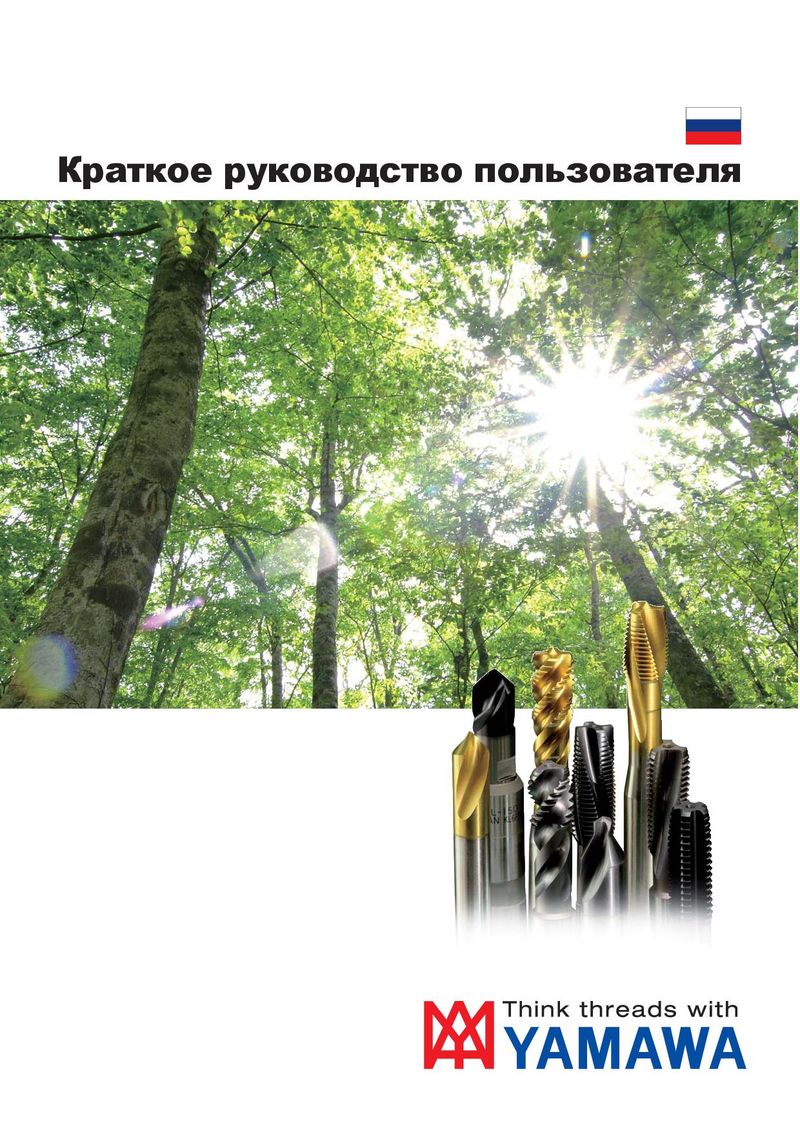 Краткое руководство Yamawa по каталогам
 Общий каталог Yamawa 2022 - 2023
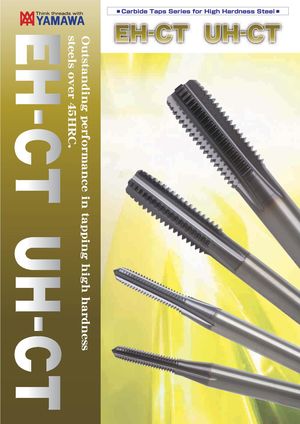 Каталоги Yamawa твердосплавные метчики для закаленной стали
16. Carbide Taps
Technological advances in CNC machines and machining centers, and machining automation have helped to improve the overall tapping
process. SP
YAMAWA was quick to answer to the evolving customer needs. We have developed a wide range of carbide taps for tremendous improvements in mass-production and cost reduction. It is estimated that carbide taps have 50 times more durability than HSS taps in tapping, when used properly. YAMAWA engineering believes the best carbide materials suitable for taps are ultramicro-grain tungsten carbide, or ultrafine-grain carbide made of high cobalt.
SL
Features of Carbide Taps
(1) Excellent durability with high toughness is obtainable. (2) High anti-friction features are provided by the material’s high hardness and comparatively high toughness, which ultimately results in a longer tool life.
(3) Specially designed cutting angle and other dimensional features produce the internal threads with high tolerance accuracy and PO
consistency. (4) Under certain tapping condition, YAMAWA carbide taps can be used even for tapping hard-to-machine materials. Points to note during tapping with Carbide taps: ST
(1) Machine vibration, or run-out, can lead to Carbide tap chipping and premature failure. Tapping vibrations need to be kept to a minimum. (2) Tap holder should be a rigid type for a Carbide tap. A holder attachment with axial float, or radial float tends to promote Carbide tap breakage and chipping. (3) The hole to be tapped must be located correctly and on center; any centering off or non-straight drilled hole tends to cause Carbide tap
| ROLL breakage due to deflection. Select correct hole depth with respect to tapping length (for blind hole only). It is especially important to | |
| prevent tap damage from chip packing and bottom thrusting in blind hole tapping. | |
| (4) Cutting lubricants - select grade of lubricant. Improper flow of coolant, or lack of sufficient amount of lubricant, or cooling can increase | |
| the likelihood of Carbide tap chipping due to work material welding. Caution must be taken during dry machining to prevent chip | |
| welding to the tap. | |
| (5) Work pieces - we provide Carbide taps with increased toughness, but Carbide taps are inferior to High Speed Steel (HSS) in the area of | CARBIDE |
toughness. As a matter of fact Carbide taps have limited application due to this difference in toughness to HSS. Commonly used materials and cutting conditions LONG
| Wo | rk Materials | Cutting Speed (m/min) | Cutting Fluid (General recommendation) |
| Ordinary | 15-25 | Dry, light oil, water soluble oil | |
| Cast Iron | Nodular Graphite | 10-20 | Light oil, water soluble oil |
| Malleable | 10-20 | Water soluble oil | |
| Aluminum | 20-40 | Light oil, water soluble oil | |
| Copper | 15-30 | Light oil, water soluble oil | |
| C All | Brass | 20-30 | Light oil, water soluble oil |
| opper oy | Phosphor Bronze | 15-30 | Light oil, water soluble oil |
| Di-Ct | Aluminum Alloy | 15-25 | Mixed oil of lard oil and kerosene |
| eas | Zinc Alloy | 12-20 | Mixed oil of lard oil and kerosene |
| Thermosetting | 15-25 | Water soluble oil, air | |
| Plastic | Thermo Plastic | 15-25 | Water soluble oil, air |
| Hard Rubber | 15-30 | Dry, air |
GAUGES
Note: The table shows only general conditions. As for actual cutting operation, please consider the following points: (1) Machine Capacity, (2) Work piece(s), (3) Work Shape, (4) Setup (5) other factors.