Общий каталог Yamawa 2021 - страница 641
Навигация
 Обший каталог Yamawa 2016 - 2017
 Краткое руководство Yamawa по каталогам
 Общий каталог Yamawa 2022 - 2023
 Каталоги Yamawa твердосплавные метчики для закаленной стали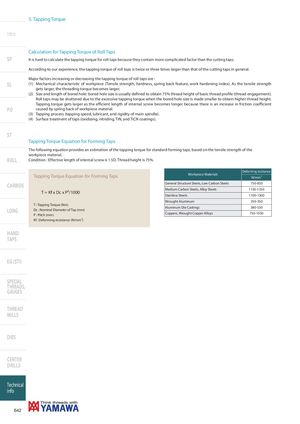
Calculation for Tapping Torque of Roll Taps
SP It is hard to calculate the tapping torque for roll taps because they contain more complicated factor than the cutting taps. According to our experience, the tapping torque of roll taps is twice or three times larger than that of the cutting taps in general. Major factors increasing or decreasing the tapping torque of roll taps are : SL (1) Mechanical characteristic of workpiece (Tensile strength, hardness, spring back feature, work hardening index). As the tensile strength gets larger, the threading torque becomes larger. (2) Size and length of bored hole: bored hole size is usually defined to obtain 75% thread height of basic thread profile (thread engagement). Roll taps may be shuttered due to the excessive tapping torque when the bored hole size is made smaller to obtain higher thread height. Tapping torque gets larger as the efficient length of internal screw becomes longer because there is an increase in friction coefficient PO caused by spring back of workpiece material. (3) Tapping process (tapping speed, lubricant, and rigidity of main spindle). (4) Surface treatment of taps (oxidizing, nitriding, TiN, and TiCN coatings).
ST
Tapping Torque Equation for Forming Taps
The following equation provides an estimation of the tapping torque for standard forming taps, based on the tensile strength of the workpiece material. ROLL Condition : Effective length of internal screw is 1.5D. Thread height is 75%.
| Tapping Torque Equation for Forming Taps | Workpiece Materials | Deforming resistance N/mm 2 |
| General Structure Steels, Low Carbon Steels | 750-850 | |
| T Kf D P2/1000 | Medium Carbon Steels, Alloy Steels | 1150-1350 |
| = xcx | Stainless Steels | 1100-1300 |
| Wrought Aluminum | 250-350 | |
| T : Tapping Torque (Nm) Dc : Nominal Diameter of Ta (mm) | Aluminum Die Castings | 380-530 |
| p P : Pitch (mm) | Coppers, Wrought Copper Alloys | 750-1050 |
| Kf : Deforming resistance (N/mm 2) |
HAND
TAPS
EG (STI)
SPECIAL
THREADS,