Каталог Widia инструментальная оснастка - страница 1103
Навигация
 Каталог Widia достижения 2021
 Брошюра Widia решения для аэрокосмической промышленности
 Брошюра Widia техническое руководство
 Каталог Widia токарный инструмент 2020
 Каталог Widia цельные концевые фрезы
 Каталог Widia техническое руководство по разверткам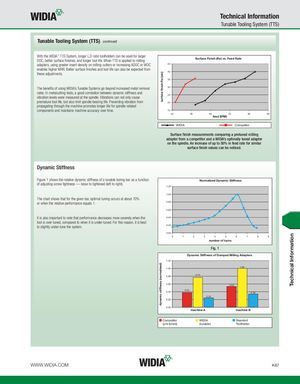
Tunable Tooling System (TTS)
Tunable Tooling System (TTS) (continued)
With the WIDIA™ TTS System, longer L:D ratio toolholders can be used for larger
DOC, better surface finishes, and longer tool life. When TTS is applied to milling
adapters, using greater insert density on milling cutters or increasing ADOC or WOC
enables higher MRR. Better surface finishes and tool life can also be expected from
these adjustments.
The benefits of using WIDIA’s Tunable Systems go beyond increased metal removal
rates. In metalcutting tests, a good correlation between dynamic stiffness and
vibration levels were measured at the spindle. Vibrations can not only cause
premature tool life, but also limit spindle bearing life. Preventing vibration from
propagating through the machine promotes longer life for spindle-related
components and maintains machine accuracy over time.
Surface Finish (Ra) vs. Feed Rate 45 40 35 30 25 20 15 40 50 60 70 80 90 feed (IPM)
WIDIA Competitor
Surface finish measurements comparing a pretuned milling
adapter from a competitor and a WIDIA’s optimally tuned adapter
on the spindle. An increase of up to 50% in feed rate for similar
surface finish values can be noticed.
Dynamic Stiffness
Figure 1 shows the relative dynamic stiffness of a tunable boring bar as a function Normalized Dynamic Stiffness of adjusting screw tightness — loose to tightened (left to right). 1.20 1.00
The chart shows that for the given bar, optimal tuning occurs at about 70%
or when the relative performance equals 1. 0.80 0.60 It is also important to note that performance decreases more severely when the 0.40
tool is over-tuned, compared to when it is under-tuned. For this reason, it is best
to slightly under-tune the system. 0.20 0.00
0 1 2 3 4 5 6 7 8 9
number of turns Fig. 1 Dynamic Stiffness of Damped Milling Adapters 1.20
1.00 1.00 0.80 0.75
0.60 0.53 0.34 0.40 0.32 0.25 0.20 0.00 machine A machine B
| Competitor | WIDIA | Standard |
| (pre-tuned) | (tunable) | Toolholder |