Каталог Widia инструментальная оснастка - страница 1092
Навигация
 Каталог Widia достижения 2021
 Брошюра Widia решения для аэрокосмической промышленности
 Брошюра Widia техническое руководство
 Каталог Widia токарный инструмент 2020
 Каталог Widia цельные концевые фрезы
 Каталог Widia техническое руководство по разверткам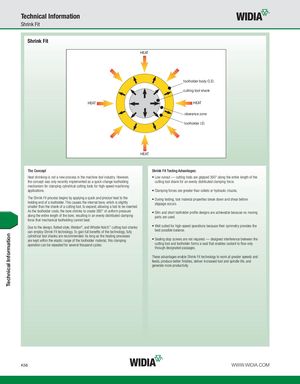
Shrink Fit
HEAT
toolholder body O.D. cutting tool shank
HEAT HEAT
clearance zone toolholder I.D.
HEAT
| The Concept | Shrink Fit Tooling Advantages: |
| Heat shrinking is not a new process in the machine tool industry. However, | • Low runout — cutting tools are gripped 360° along the entire length of the |
| the concept was only recently implemented as a quick-change toolholding | cutting tool shank for an evenly distributed clamping force. |
| mechanism for clamping cylindrical cutting tools for high-speed machining | |
| applications. | • Clamping forces are greater than collets or hydraulic chucks. |
| The Shrink Fit process begins by applying a quick and precise heat to the | • During testing, tool material properties break down and shear before |
| holding end of a toolholder. This causes the internal bore, which is slightly | slippage occurs. |
| smaller than the shank of a cutting tool, to expand, allowing a tool to be inserted. | |
| As the toolholder cools, the bore shrinks to create 360° of uniform pressure | • Slim and short toolholder profile designs are achievable because no moving |
| along the entire length of the bore, resulting in an evenly distributed clamping | parts are used. |
| force that mechanical toolholding cannot beat. | |
| Due to the design, flatted-style, Weldon | • Well suited for high-speed operations because their symmetry provides the |
| ®, and Whistle Notch™ cutting tool shanks | |
| can employ Shrink Fit technology. To gain full benefits of the technology, fully | best possible balance. |
| cylindrical tool shanks are recommended. As long as the heating processes | |
| are kept within the elastic range of the toolholder material, this clamping | • Sealing stop screws are not required — designed interference between the |
| operation can be repeated for several thousand cycles. | cutting tool and toolholder forms a seal that enables coolant to flow only |
through designated passages. These advantages enable Shrink Fit technology to work at greater speeds and feeds, produce better finishes, deliver increased tool and spindle life, and generate more productivity.