Каталог Widia инструментальная оснастка - страница 1038
Навигация
 Каталог Widia достижения 2021
 Брошюра Widia решения для аэрокосмической промышленности
 Брошюра Widia техническое руководство
 Каталог Widia токарный инструмент 2020
 Каталог Widia цельные концевые фрезы
 Каталог Widia техническое руководство по разверткам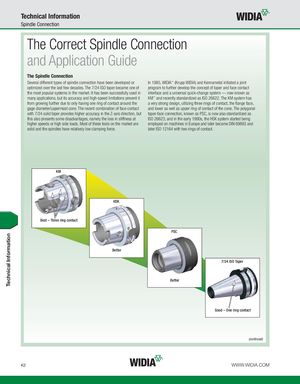
Spindle Connection
The Correct Spindle Connection
and Application Guide
The Spindle Connection
| Several different types of spindle connection have been developed or | In 1985, WIDIA™ (Krupp WIDIA) and Kennametal initiated a joint |
| optimized over the last few decades. The 7/24 ISO taper became one of | program to further develop the concept of taper and face contact |
| the most popular systems in the market. It has been successfully used in | interface and a universal quick-change system — now known as |
| many applications, but its accuracy and high-speed limitations prevent it | KM™ and recently standardized as ISO 26622. The KM system has |
| from growing further due to only having one ring of contact around the | a very strong design, utilizing three rings of contact, the flange face, |
| gage diameter/uppermost cone. The recent combination of face contact | and lower as well as upper ring of contact of the cone. The polygonal |
| with 7/24 solid taper provides higher accuracy in the Z-axis direction, but | taper-face connection, known as PSC, is now also standardized as |
| this also presents some disadvantages, namely the loss in stiffness at | ISO 26623, and in the early 1990s, the HSK system started being |
| higher speeds or high side loads. Most of these tools on the market are | employed on machines in Europe and later became DIN 69893 and |
| solid and the spindles have relatively low clamping force. | later ISO 12164 with two rings of contact. |
KM
HSK
Best – Three ring contact
PSC
Better
7/24 ISO Taper
Better
Good – One ring contact
(continued)