Каталог Tungaloy зубофрезерование - страница 58
Навигация
 Общий каталог Tungaloy 2020 - 2021
 Каталог Tungaloy инструмент для автоматов швейцарского типа
 Каталог Tungaloy глубокое сверление 2
 Каталог Tungaloy глубокое сверление 1
 Брошюра Tungaloy новая продукция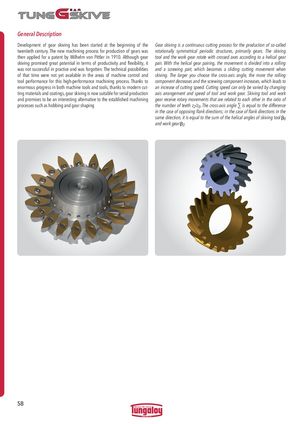
| Development of gear skiving has been started at the beginning of the | Gear skiving is a continuous cutting process for the production of so-called |
| twentieth century. The new machining process for production of gears was | rotationally symmetrical periodic structures, primarily gears. The skiving |
| then applied for a patent by Wilhelm von Pittler in 1910. Although gear | tool and the work gear rotate with crossed axes according to a helical gear |
| skiving promised great potential in terms of productivity and flexibility, it | pair. With the helical gear pairing, the movement is divided into a rolling |
| was not successful in practice and was forgotten. The technical possibilities | and a screwing part, which becomes a sliding cutting movement when |
| of that time were not yet available in the areas of machine control and | skiving. The larger you choose the cross-axis angle, the more the rolling |
| tool performance for this high-performance machining process. Thanks to | component decreases and the screwing component increases, which leads to |
| enormous progress in both machine tools and tools, thanks to modern cut- | an increase of cutting speed. Cutting speed can only be varied by changing |
| ting materials and coatings, gear skiving is now suitable for serial production | axis arrangement and speed of tool and work gear. Skiving tool and work |
| and promises to be an interesting alternative to the established machining | gear receive rotary movements that are related to each other in the ratio of |
| processes such as hobbing and gear shaping | the number of teeth z2/z0. The cross-axis angle ∑ is equal to the difference |
| in the case of opposing flank directions; in the case of flank directions in the | |
| 0 same direction, it is equal to the sum of the helical angles of skiving tool |
and work gear 2.