Каталог Tungaloy зубофрезерование - страница 50
Навигация
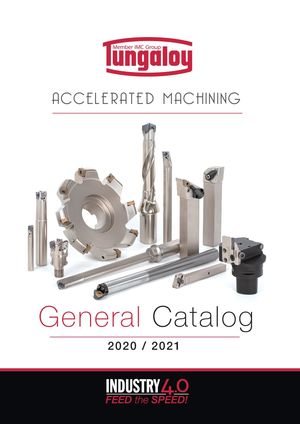 Общий каталог Tungaloy 2020 - 2021
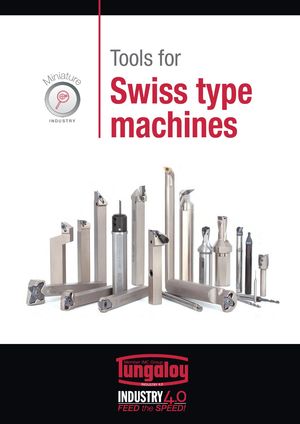 Каталог Tungaloy инструмент для автоматов швейцарского типа
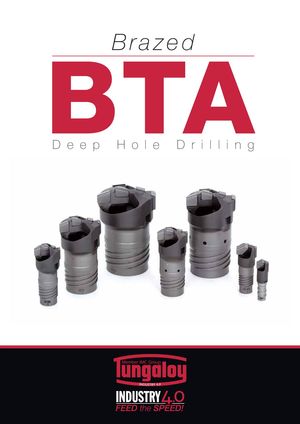 Каталог Tungaloy глубокое сверление 2
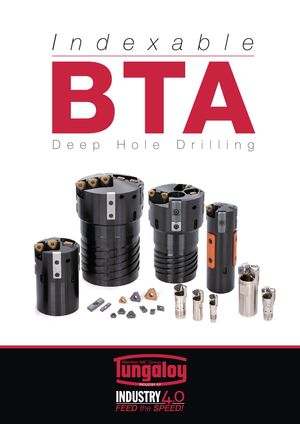 Каталог Tungaloy глубокое сверление 1
 Брошюра Tungaloy новая продукция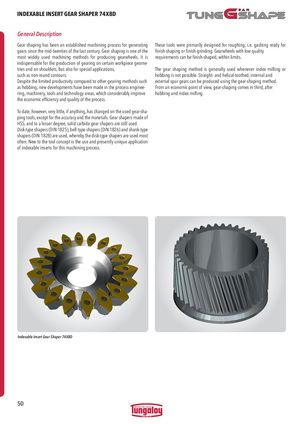
INDEXABLE INSERT GEAR SHAPER 74X8D
| Gear shaping has been an established machining process for generating | These tools were primarily designed for roughing, i.e. gashing ready for |
| gears since the mid-twenties of the last century. Gear shaping is one of the | finish-shaping or finish-grinding. Gearwheels with low quality |
| most widely used machining methods for producing gearwheels. It is | requirements can be finish-shaped, within limits. |
| indispensable for the production of gearing on certain workpiece geome- | |
| tries and on shoulders, but also for special applications, | The gear shaping method is generally used whenever index milling or |
| such as non-round contours. | hobbing is not possible. Straight- and helical-toothed, internal and |
| Despite the limited productivity compared to other gearing methods such | external spur gears can be produced using the gear-shaping method. |
| as hobbing, new developments have been made in the process enginee- | From an economic point of view, gear-shaping comes in third, after |
| ring, machinery, tools and technology areas, which considerably improve | hobbing and index milling. |
the economic efficiency and quality of the process. To date, however, very little, if anything, has changed on the used gear-sha- ping tools, except for the accuracy and the materials. Gear shapers made of HSS, and to a lesser degree, solid carbide gear shapers are still used.
Disk-type shapers (DIN 1825), bell-type shapers (DIN 1826) and shank-type shapers (DIN 1828) are used, whereby the disk-type shapers are used most often. New to the tool concept is the use and presently unique application of indexable inserts for this machining process.
Indexable Insert Gear Shaper 74X8D