Общий каталог Sumitomo 2018 - 2019 - страница 35
Навигация
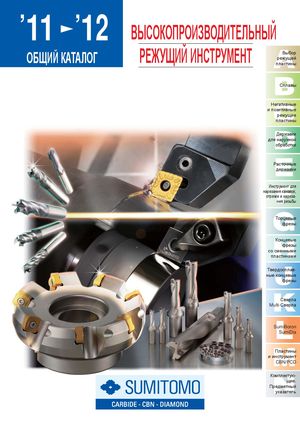 Общий каталог Sumitomo 2012
 Каталог Sumitomo резьбонарезной инструмент
 Каталог Sumitomo пластины с режущей кромкой-моноалмаз Sumicristal
 Каталог Sumitomo инструмент для обработки канавок
 Общий каталог Sumitomo 2019 - 2020
 Каталог Sumitomo запасные части
- Pages 3-6_CS6_EN_web
- A 1-20 insert selection EN_web
- B 1-14 grades_EN_web
- C01-17 inserts intro pages_EN_web
- C18-56 negative inserts_EN_web
- C57-86 positive inserts_EN_web
- D 1-46 tool holders_EN_web
- E 1-24 boring bars_EN_web
- F 1-48 grooving_thread tools_EN_web
- G 1-54 milling cutters_EN_web
- H 1-48 insert type endmills_EN_web
- J 1-24 new endmills_EN_web
- J 25-50 endmills_EN_web
- K 1-46 Multi-Drills_EN_web
- K 47-76 Multi-Drills_EN_web
- L 1-28 cbn_pcd grades_EN_web
- M 1-34 cbn_pcd inserts_EN_web
- M 35-56 SHM tools_EN_web
- N1-24 technical guidance_EN_web
- P 1-8 spare parts_neu_EN_web
- P 9-22 index_notes_EN_web
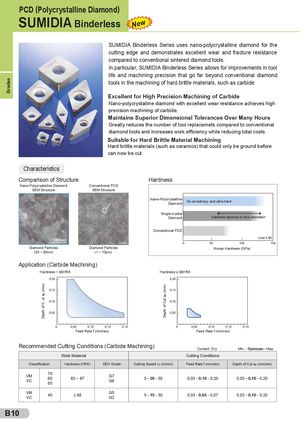
PCD (Polycrystalline Diamond)
SUMIDIA Binderless Series uses nano-polycrystalline diamond for the
cutting edge and demonstrates excellent wear and fracture resistance
compared to conventional sintered diamond tools.
In particular, SUMIDIA Binderless Series allows for improvements in tool
life and machining precision that go far beyond conventional diamond
tools in the machining of hard brittle materials, such as carbide.
Excellent for High Precision Machining of Carbide
Nano-polycrystalline diamond with excellent wear resistance achieves high
precision machining of carbide.
Maintains Superior Dimensional Tolerances Over Many Hours
Greatly reduces the number of tool replacemets compared to conventional
diamond tools and increases work efficiency while reducing total costs.
Suitable for Hard Brittle Material Machining
Hard brittle materials (such as ceramics) that could only be ground before
can now be cut.
Characteristics
Comparison of Structure Hardness
Nano-Polycrystalline Diamond Conventional PCD SEM Structure SEM Structure Nano-Polycrystalline Diamond No anisotropy and ultra-hard Single-crystal Diamond Hardness depends on face orientation
Conventional PCD Load 4,9N
0 50 100 150
| Diamond Particles | Knoop Hardness (GPa) Diamond Particles |
| (30 ~ 50nm) | (1 ~ 10μm) |
| Application (Carbide Machining) | |
| Hardness < 88HRA | Hardness ≥ 88HRA |
| 0,20 | 0,20 |
| 0,15 | 0,15 |
| 0,10 | 0,10 |
| 0,05 | 0,05 |
0 0,05 0,10 0,15 0,15 0 0,05 0,10 0,15 0,15
Feed Rate f (mm/rev) Feed Rate f (mm/rev) Recommended Cutting Conditions (Carbide Machining) Coolant: Dry Min. - Optimum - Max.
| Work Material | Cutting Conditions | |||||
| Classifi | ication | Hardness (HRA) | SEH Grade | Cutting Speed vc(m/min) | Feed Rate f (mm/rev) | Depth of Cut ap(mm/rev) |
| VM VC | 70 60 50 | 83 ~ 87 | G7 G6 | 5 -20- 30 | 0,03 -0,10- 0,20 | 0,03 -0,10- 0,20 |
| VM VC | 40 | ≥ 88 | G5 G2 | 5 -15- 30 | 0,03 -0,05- 0,07 | 0,03 -0,10- 0,20 |