Каталог Iscar вращающийся инструмент 2017 - страница 945
Навигация
 Каталог Iscar токарные пластины ISO 2022
 Каталог Iscar инструмент для фрезерования
 Каталог Iscar решения для глубокого сверления
 Каталог Iscar полирующие фрезы
 Каталог Iscar новые продукты 2018
 Каталог Iscar концевые фрезы со сменными пластинами 2022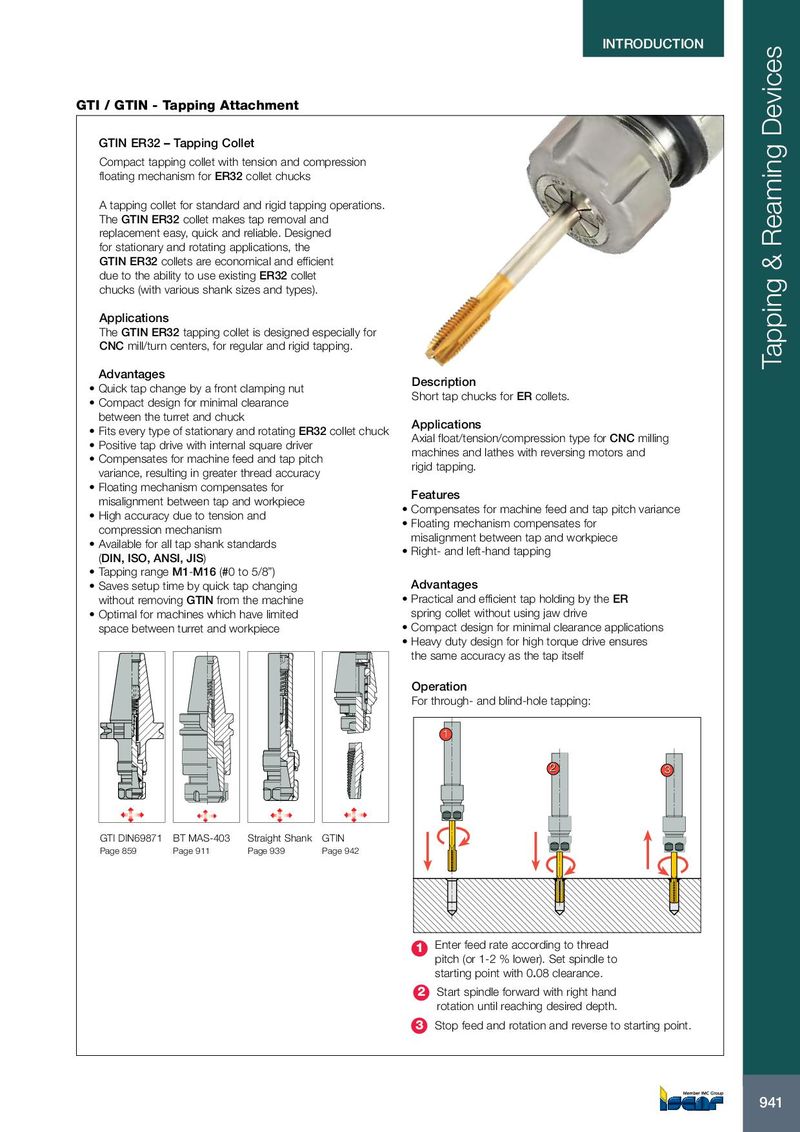
INTRODUCTION GTI / GTIN - Tapping Attachment GTIN ER32 – Tapping Collet Compact tapping collet with tension and compression floating mechanism for ER32 collet chucks A tapping collet for standard and rigid tapping operations. The GTIN ER32 collet makes tap removal and replacement easy, quick and reliable. Designed for stationary and rotating applications, the GTIN ER32 collets are economical and efficient due to the ability to use existing ER32 collet chucks (with various shank sizes and types). Applications The GTIN ER32 tapping collet is designed especially for CNC mill/turn centers, for regular and rigid tapping. Tapping & Reaming Devices Advantages Description • Quick tap change by a front clamping nut Short tap chucks for ER collets. • Compact design for minimal clearance between the turret and chuck Applications • Fits every type of stationary and rotating ER32 collet chuck Axial float/tension/compression type for CNC milling • Positive tap drive with internal square driver machines and lathes with reversing motors and • Compensates for machine feed and tap pitch rigid tapping. variance, resulting in greater thread accuracy • Floating mechanism compensates for Features misalignment between tap and workpiece • Compensates for machine feed and tap pitch variance • High accuracy due to tension and • Floating mechanism compensates for compression mechanism misalignment between tap and workpiece • Available for all tap shank standards • Right- and left-hand tapping (DIN, ISO, ANSI, JIS) • Tapping range M1-M16 (#0 to 5/8”) • Saves setup time by quick tap changing Advantages without removing GTIN from the machine • Practical and efficient tap holding by the ER • Optimal for machines which have limited spring collet without using jaw drive space between turret and workpiece • Compact design for minimal clearance applications • Heavy duty design for high torque drive ensures the same accuracy as the tap itself Operation For through- and blind-hole tapping: 1 1 2 2 3 3 GTI DIN69871 BT MAS-403 Straight Shank GTIN Page 859 Page 911 Page 939 Page 942 1 Enter feed rate according to thread pitch (or 1-2 % lower). Set spindle to starting point with 0.08 clearance. 2 Start spindle forward with right hand rotation until reaching desired depth. 3 Stop feed and rotation and reverse to starting point. 941