Каталог Iscar вращающийся инструмент 2017 - страница 671
Навигация
 Каталог Iscar токарные пластины ISO 2022
 Каталог Iscar инструмент для фрезерования
 Каталог Iscar решения для глубокого сверления
 Каталог Iscar полирующие фрезы
 Каталог Iscar новые продукты 2018
 Каталог Iscar концевые фрезы со сменными пластинами 2022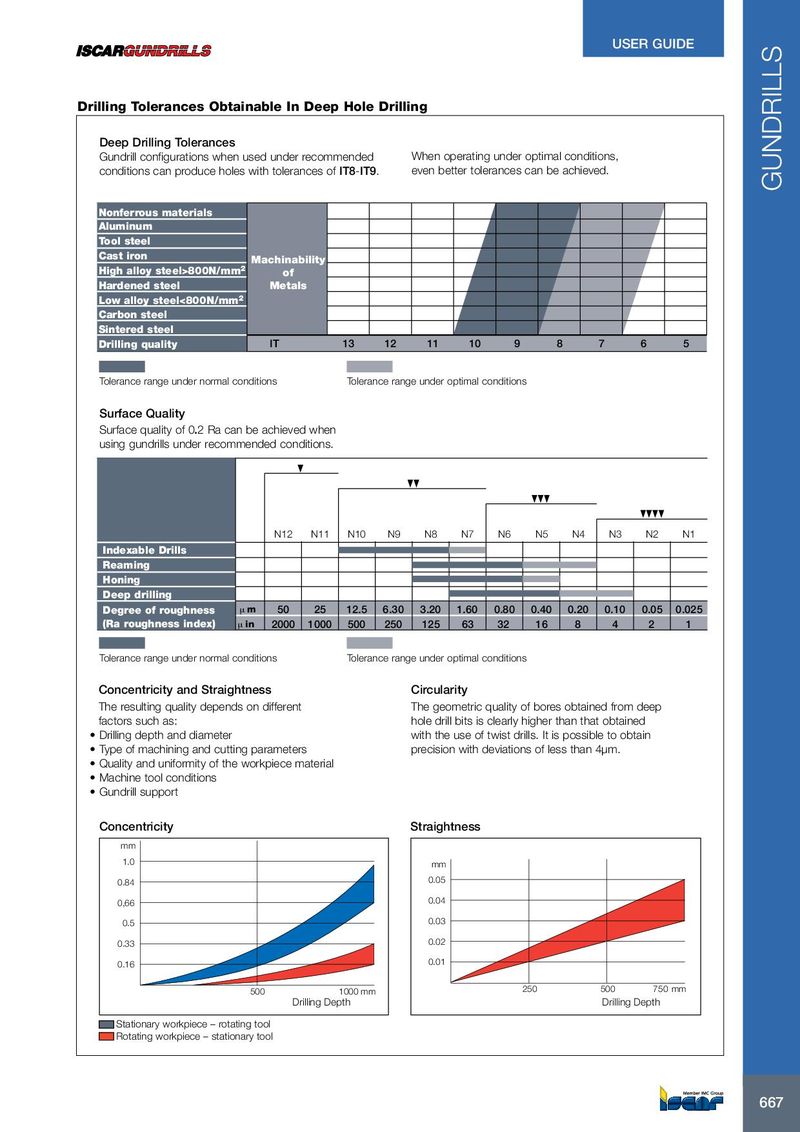
USER GUIDE Drilling Tolerances Obtainable In Deep Hole Drilling Deep Drilling Tolerances Gundrill configurations when used under recommended When operating under optimal conditions, conditions can produce holes with tolerances of IT8-IT9. even better tolerances can be achieved. Nonferrous materials Aluminum Tool steel Cast iron Machinability High alloy steel>800N/mm 2 of Hardened steel Metals Low alloy steel<800N/mm 2 Carbon steel Sintered steel Drilling quality IT 13 12 11 10 9 8 7 6 5 Tolerance range under normal conditions Tolerance range under optimal conditions Surface Quality Surface quality of 0.2 Ra can be achieved when using gundrills under recommended conditions. N12 N11 N10 N9 N8 N7 N6 N5 N4 N3 N2 N1 Indexable Drills Reaming Honing Deep drilling Degree of roughness µ m 50 25 12.5 6.30 3.20 1.60 0.80 0.40 0.20 0.10 0.05 0.025 (Ra roughness index) µ in 2000 1000 500 250 125 63 32 16 8 4 2 1 Tolerance range under normal conditions Tolerance range under optimal conditions GUNDRILLS Concentricity and Straightness Circularity The resulting quality depends on different The geometric quality of bores obtained from deep factors such as: hole drill bits is clearly higher than that obtained • Drilling depth and diameter with the use of twist drills. It is possible to obtain • Type of machining and cutting parameters precision with deviations of less than 4µm. • Quality and uniformity of the workpiece material • Machine tool conditions • Gundrill support Concentricity Straightness mm 1.0 mm 0.84 0.05 0,66 0.04 0.5 0.03 0.33 0.02 0.16 0.01 500 mm 1000 250 500 mm 750 Drilling Depth Drilling Depth Stationary workpiece – rotating tool Rotating workpiece – stationary tool 667