Каталог Iscar токарный инструмент 2017 - страница 210
Навигация
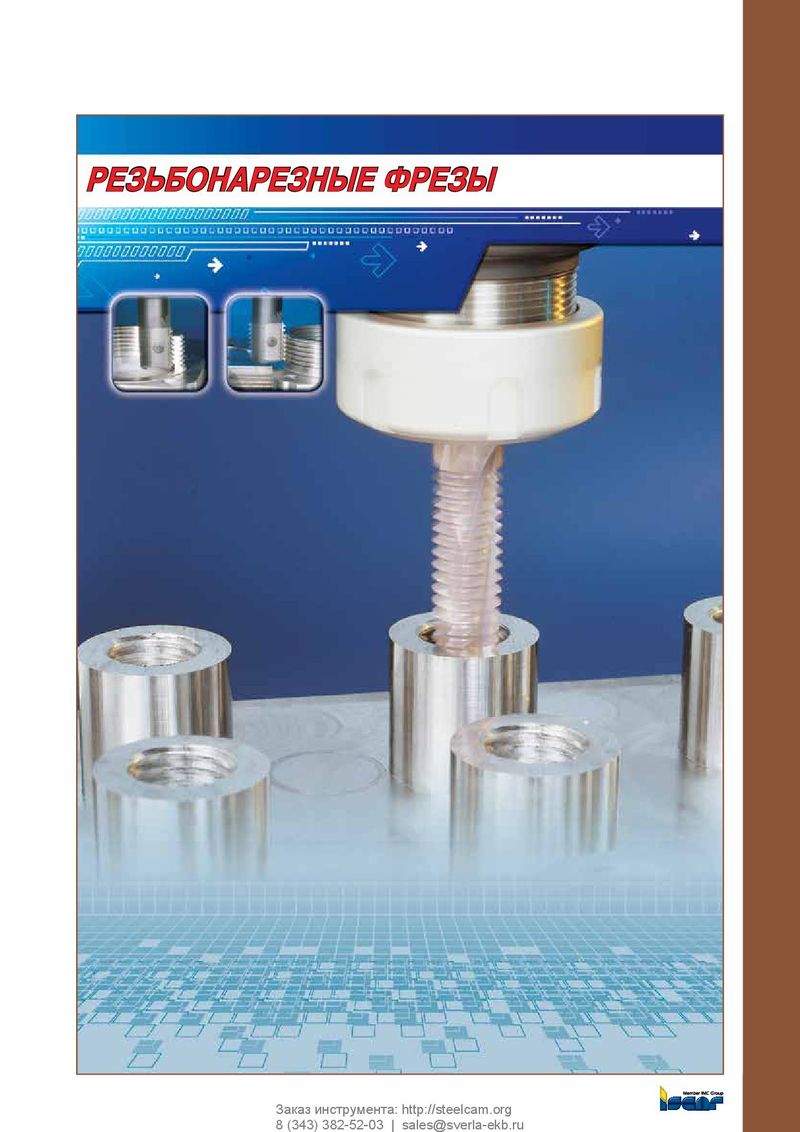 Каталог Iscar резьбонарезные фрезы
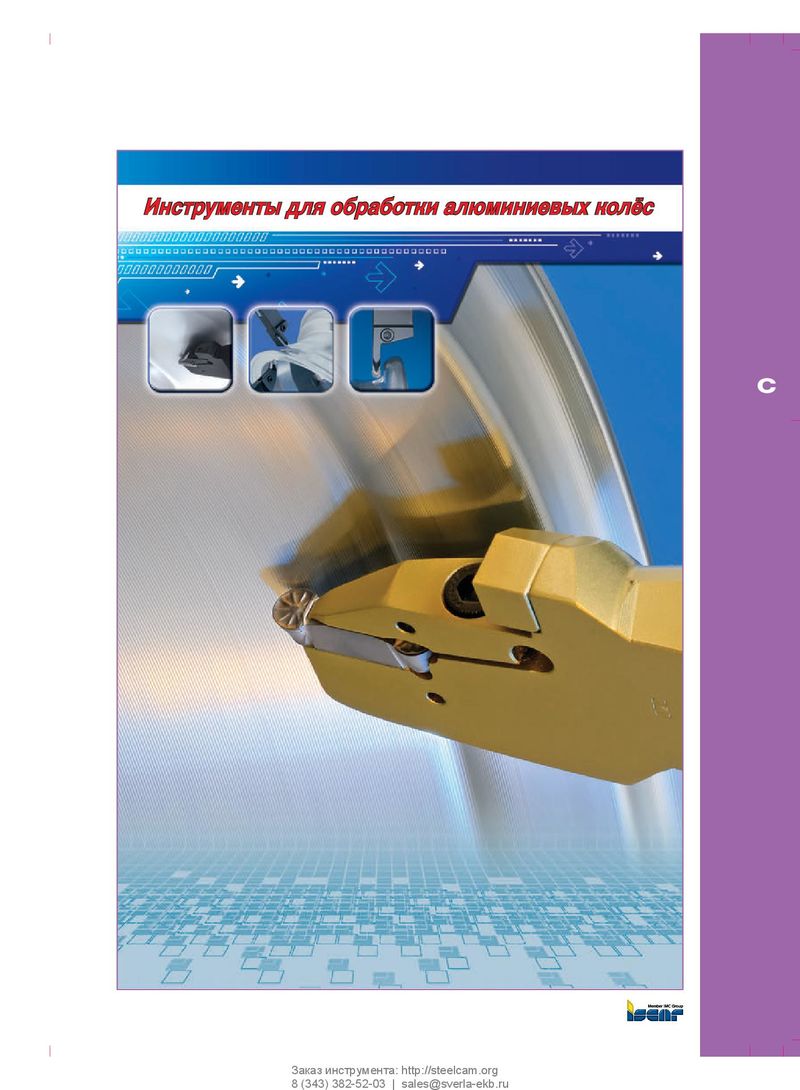 Каталог Iscar инструмент для обработки алюминиевых колёс
 Каталог Iscar державки и пластины для нарезания резьбы 2022
 Каталог Iscar расточные системы 2022
 Каталог Iscar высокоточные развертки и метчики 2022
 Токарные инструменты Iscar (часть 2) 2026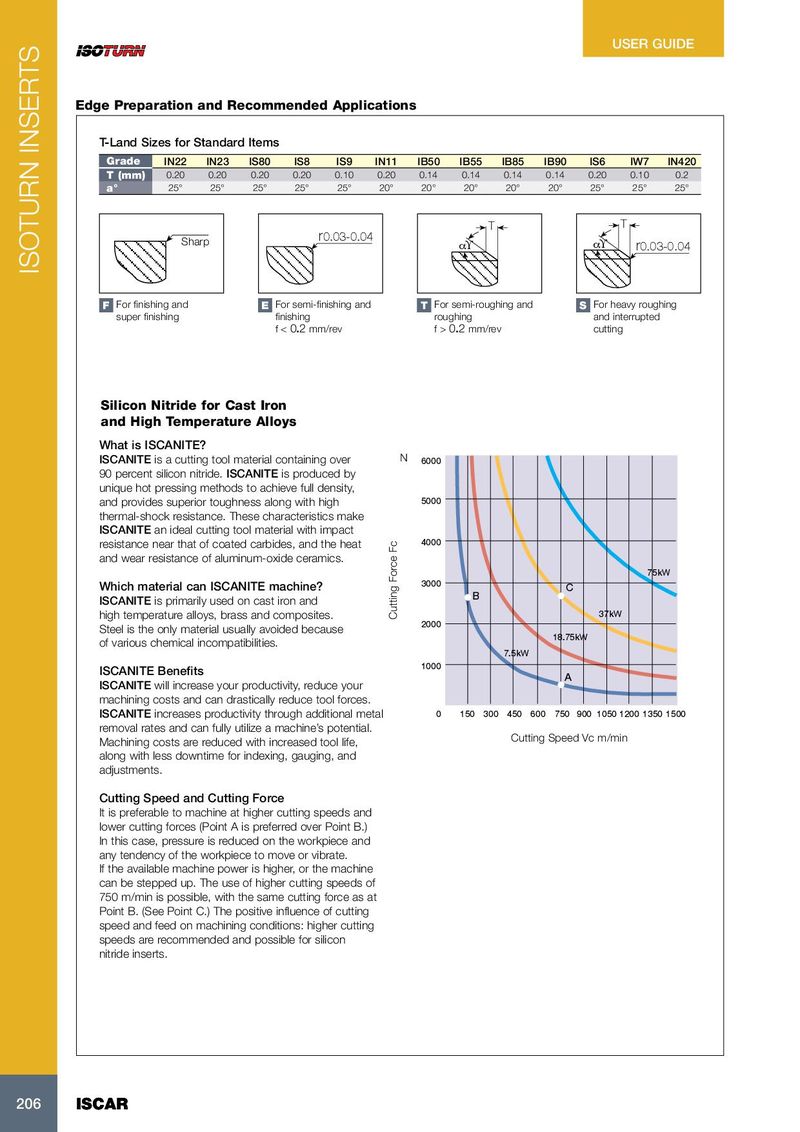
Edge Preparation and Recommended Applications
T-Land Sizes for Standard Items
| Grade | IN22 | IN23 | IS80 | IS8 | IS9 | IN11 | IB50 | IB55 | IB85 | IB90 | IS6 | IW7 | IN420 |
| T (mm) | 0.20 | 0.20 | 0.20 | 0.20 | 0.10 | 0.20 | 0.14 | 0.14 | 0.14 | 0.14 | 0.20 | 0.10 | 0.2 |
| a° | 25° | 25° | 25° | 25° | 25° | 20° | 20° | 20° | 20° | 20° | 25° | 25° | 25° |
| T | T | ||||||||||||
| r0.03-0.04 | |||||||||||||
| Sharp | αϒ | αϒ | r0.03-0.04 |
F• For finishing and E• For semi-finishing and T• For semi-roughing and S• For heavy roughing
| super finishing | finishing | roughing | and interrupted |
| f < 0.2 mm/rev | f > 0.2 mm/rev | cutting |
Silicon Nitride for Cast Iron
and High Temperature Alloys
What is ISCANITE?
ISCANITE is a cutting tool material containing over N 6000
90 percent silicon nitride. ISCANITE is produced by unique hot pressing methods to achieve full density, and provides superior toughness along with high 5000 thermal-shock resistance. These characteristics make
ISCANITE an ideal cutting tool material with impact resistance near that of coated carbides, and the heat 4000 and wear resistance of aluminum-oxide ceramics. 75kW
Which material can ISCANITE machine? 3000 C
ISCANITE is primarily used on cast iron and B high temperature alloys, brass and composites. 37kW Steel is the only material usually avoided because 2000 of various chemical incompatibilities. 18.75kW
7.5kW ISCANITE Benefits 1000 A ISCANITE will increase your productivity, reduce your machining costs and can drastically reduce tool forces.
ISCANITE increases productivity through additional metal 0 150 300 450 600 750 900 1050 1200 1350 1500
removal rates and can fully utilize a machine’s potential. Machining costs are reduced with increased tool life, Cutting Speed Vc m/min along with less downtime for indexing, gauging, and adjustments.
Cutting Speed and Cutting Force It is preferable to machine at higher cutting speeds and lower cutting forces (Point A is preferred over Point B.) In this case, pressure is reduced on the workpiece and any tendency of the workpiece to move or vibrate. If the available machine power is higher, or the machine can be stepped up. The use of higher cutting speeds of 750 m/min is possible, with the same cutting force as at Point B. (See Point C.) The positive influence of cutting speed and feed on machining conditions: higher cutting speeds are recommended and possible for silicon nitride inserts.