Средства индивидуальной защиты Hoffmann Group 2026 - страница 378
Навигация
 Новые режущие инструменты, производственная мебель и средства защиты Hoffmann Group 2027
 Каталог Hoffmann Group запасные части, оснастка и СИЗ
 Каталог Hoffmann Group ручной и измерительный инструмент
 Каталог Hoffmann Group режущий и вспомогательный инструмент
 Производственная мебель и системы хранения Hoffmann Group 2026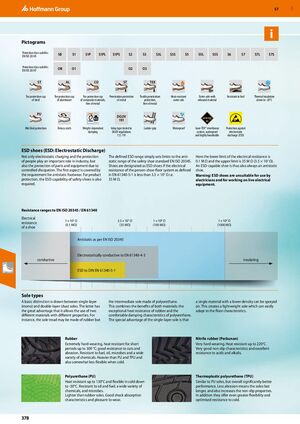
Пиктограммы
| Обозначение класса защиты | SB | S1 | S1P | S1PL | S1PS | S2 | S3 | S3L | S3S | S5 | S5L | S5S | S6 | S7 | S7L | S7S |
|---|---|---|---|---|---|---|---|---|---|---|---|---|---|---|---|---|
| Классы EN ISO 20345 | ● | ● | ● | ● | ● | ● | ● | ● | ● | ● | ● | ● | ● | ● | ● | ● |
| Обозначение класса защиты | OB | O1 | O2 | O3 |
|---|---|---|---|---|
| Классы EN ISO 20347 | ● | ● | ● | ● |
| ST | AL | CO | ST | TEX | PU | KG | DGUV 191 |
|---|---|---|---|---|---|---|---|
| Защитный колпак на носке из стали | Защитный колпак на носке из алюминия | Защитный колпак на носке из композитных материалов, без содержания металла | Защита от прокола металлическим гвоздём | Текстильная защита от прокола, без содержания металла | Температуростойкая подошва | Подошва с амортизирующим материалом | Устойчивость к топливу |
| Защита средней части стопы | Ротационный захват | Амортизация в зависимости от веса | Вкладыш, испытанный в соответствии с правилами DGUV 112-191 | Захват лестницы | Водонепроницаемый | Мембранная система Gore-TEX®, водонепроницаемая и высоко дышащая | Защита от электростатического разряда (ЭСР) |
Защитная обувь от электростатического разряда (ЭСР)
В промышленности роль играют не только электростатическое зарядное и защита людей, но и защита деталей и оборудования благодаря контролируемому рассеиванию. Первый аспект охватывается требованием антистатической обуви. Для защиты продукции также требуется способность обуви защищать от ЭСР.
Установленный диапазон ЭСР просто устанавливает пределы антистатического диапазона стандарта защитной обуви EN ISO 20345. Обувь обозначается как обувь ЭСР, если электрическое сопротивление системы человек-обувь-пол, как определено в EN 61340-5-1, составляет менее 3,5 × 10⁷ Ω, то есть 35 МΩ. Нижний предел электрического сопротивления составляет 0,1 МΩ, а верхний предел — 35 МΩ (3,5 × 10⁷ Ω). Обувь, способная к ЭСР, таким образом, всегда является также антистатической обувью.
Предупреждение: обувь ЭСР непригодна для использования электриками и для работы с токоведущим электрооборудованием.
Диапазоны электрического сопротивления к EN ISO 20345 / EN 61340
| Электрическое сопротивление | 1 × 10⁵ Ω (0,1 MΩ) | 3,5 × 10⁷ Ω (35 MΩ) | 1 × 10⁸ Ω (100 MΩ) | 1 × 10⁹ Ω (1000 MΩ) |
|---|---|---|---|---|
| Антистатическая обувь согласно EN ISO 20345 | Электропроводная обувь согласно EN 61340-4-3 | |||
| токопроводящая | ЭСР согласно DIN EN 61340-5-1 | изолирующая |
Типы подошв
Основное различие проводится между однослойными (моно) и двухслойными (дуо) подошвами. Последний имеет большое преимущество, заключающееся в том, что он позволяет использовать два разных материала с разными свойствами. Например, протектор подошвы может быть выполнен из резины, но промежуточная подошва изготовлена из полиуретана. Это сочетает в себе преимущества обоих материалов: исключительную температуростойкость резины и удобные амортизирующие характеристики полиуретана. Особое преимущество однослойной подошвы заключается в том, что можно распылить один материал с более низкой плотностью. Это создаёт лёгкую подошву, которая легко может приспосабливаться к характеристикам пола.
Резина
Чрезвычайно износостойкая, температуростойкая кратковременно до 300 °C; хорошая устойчивость к порезам и истиранию. Устойчива к топливу, маслу, микробам и широкому спектру химических веществ. Тяжелее ПУ и ТПУ и также несколько менее гибкая в холоде.
Полиуретан (ПУ)
Температуростойкий до 130°C и гибкий в холоде до -30°C. Устойчив к маслу и топливу, широкому спектру химических веществ и микробам. Легче резиновых подошв. Хорошие амортизирующие характеристики и удобна в носке.
Нитрильная резина (Пербунан)
Очень износостойкая. Температуростойкая до 220°C. Отличные противоскользящие характеристики и отличная устойчивость к кислотам и щёлочам.
Термопластичный полиуретан (ТПУ)
Подобно подошвам ПУ, но в целом значительно лучшие характеристики. Меньшее истирание означает, что подошвы служат дольше, и также увеличивает противоскользящие свойства. Кроме того, они предлагают ещё большую гибкость и оптимизированную устойчивость к холоду.