Средства индивидуальной защиты Hoffmann Group 2026 - страница 222
Навигация
 Новые режущие инструменты, производственная мебель и средства защиты Hoffmann Group 2027
 Каталог Hoffmann Group запасные части, оснастка и СИЗ
 Каталог Hoffmann Group ручной и измерительный инструмент
 Каталог Hoffmann Group режущий и вспомогательный инструмент
 Производственная мебель и системы хранения Hoffmann Group 2026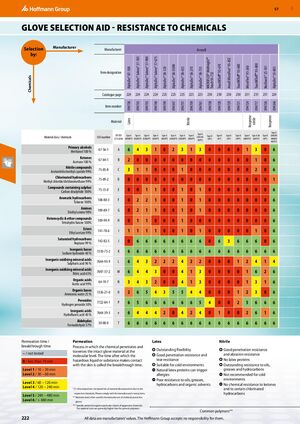
Помощник при выборе перчаток — устойчивость к химическим веществам
Производитель: Ansell
| Класс материала / Химические вещества | Номер CAS | EN ISO 374:2016 | AlphaTec® Solvex® 37-185 | AlphaTec® Solvex® 37-900 | AlphaTec® Solvex® 37-675 | MICROFLEX® MidKnight™ | Ansell MicroFlex® 93-852 | TouchNTuff™ 93-800 | TouchNTuff® 92-670 | TouchNTuff® 92-600 | AlphaTec® 58-530W | NeoTouch® 25-101 | MicroFlex® 93-260 | AlphaTec® 87-108 | AlphaTec® 58-128 | AlphaTec® 58-435 | AlphaTec® 58-270 | AlphaTec® 58-735 | AlphaTec® 53-003 | Touch 93-732 | ||
|---|---|---|---|---|---|---|---|---|---|---|---|---|---|---|---|---|---|---|---|---|---|---|
| Первичные спирты | ||||||||||||||||||||||
| Метанол 100% | 67-56-1 | A | 6 | 4 | 3 | 1 | 0 | 2 | 3 | 1 | 3 | 0 | 0 | 0 | 0 | 1 | 3 | 0 | 6 | |||
| Кетоны | ||||||||||||||||||||||
| Ацетон 100% | 67-64-1 | B | 2 | 0 | 0 | 0 | 0 | 0 | 0 | 0 | 0 | 0 | 0 | 0 | 0 | 0 | 1 | 0 | 6 | |||
| Нитрильные соединения | ||||||||||||||||||||||
| Ацетонитрил/метилцианид 99% | 75-05-8 | C | 3 | 1 | 1 | 0 | 0 | 0 | 1 | 0 | 0 | 0 | 0 | 0 | 0 | 0 | 2 | 0 | 6 | |||
| Хлорированные углеводороды | ||||||||||||||||||||||
| Хлористый метил/дихлорметан 99% | 75-09-2 | D | 0 | 0 | 0 | 0 | 0 | 0 | 0 | 0 | 0 | 0 | 0 | 0 | 0 | 0 | 0 | 0 | 1 | |||
| Соединения, содержащие серу | ||||||||||||||||||||||
| Сероуглерод 100% | 75-15-0 | E | 0 | 0 | 1 | 1 | 0 | 0 | 1 | 0 | 1 | 0 | 0 | 0 | 0 | 0 | 0 | 0 | 6 | |||
| Ароматические углеводороды | ||||||||||||||||||||||
| Толуол 100% | 108-88-3 | F | 0 | 2 | 2 | 1 | 0 | 0 | 1 | 0 | 1 | 0 | 0 | 0 | 0 | 0 | 0 | 0 | 6 | |||
| Амины | ||||||||||||||||||||||
| Диэтиламин 98% | 109-89-7 | G | 0 | 2 | 1 | 1 | 0 | 0 | 1 | 0 | 1 | 0 | 0 | 0 | 0 | 0 | 0 | 0 | 6 | |||
| Гетероциклические и эфирные соединения | ||||||||||||||||||||||
| Тетрагидрофуран 100% | 109-99-9 | H | 0 | 1 | 1 | 0 | 0 | 0 | 1 | 0 | 0 | 0 | 0 | 0 | 0 | 0 | 0 | 0 | 6 | |||
| Эфиры | ||||||||||||||||||||||
| Этилацетат 99% | 141-78-6 | I | 1 | 1 | 1 | 1 | 0 | 0 | 1 | 0 | 1 | 0 | 0 | 0 | 0 | 0 | 1 | 0 | 6 | |||
| Насыщенные углеводороды | ||||||||||||||||||||||
| Гептан 99% | 142-82-5 | J | 0 | 6 | 6 | 6 | 6 | 6 | 6 | 6 | 6 | 0 | 6 | 3 | 6 | 6 | 6 | 0 | 6 | |||
| Неорганические основания | ||||||||||||||||||||||
| Гидроксид натрия 40% | 1310-73-2 | K | 6 | 6 | 6 | 6 | 6 | 6 | 6 | 6 | 6 | 6 | 6 | 6 | 6 | 6 | 6 | 6 | 6 | |||
| Неорганические окислительные минеральные кислоты | ||||||||||||||||||||||
| Серная кислота 96% | 7664-93-9 | L | 6 | 4 | 3 | 2 | 2 | 2 | 4 | 2 | 2 | 0 | 0 | 0 | 1 | 2 | 4 | 1 | 4 | |||
| Азотная кислота 65% | 7697-37-2 | M | 6 | 4 | 4 | 3 | 0 | 0 | 4 | 1 | 3 | 0 | 0 | 0 | 0 | 1 | 6 | 2 | 6 | |||
| Органические кислоты | ||||||||||||||||||||||
| Уксусная кислота 99% | 64-19-7 | N | 3 | 4 | 3 | 2 | 0 | 0 | 4 | 1 | 3 | 0 | 0 | 0 | 0 | 1 | 3 | 1 | 6 | |||
| Органические основания | ||||||||||||||||||||||
| Аммиачная вода 25% | 1336-21-6 | O | 2 | 6 | 5 | 4 | 3 | 5 | 5 | 4 | 4 | 0 | 0 | 0 | 1 | 2 | 3 | 0 | 6 | |||
| Пероксиды | ||||||||||||||||||||||
| Перекись водорода 30% | 7722-84-1 | P | 6 | 5 | 6 | 6 | 6 | 6 | 6 | 6 | 5 | 4 | 0 | 0 | 2 | 5 | 6 | 6 | 6 | |||
| Неорганические кислоты | ||||||||||||||||||||||
| Фтористоводородная кислота 40% | 7664-39-3 | e | 6 | 4 | 4 | 4 | 2 | 0 | 4 | 2 | 4 | 0 | 1 | 0 | 0 | 2 | 6 | 1 | 6 | |||
| Альдегиды | ||||||||||||||||||||||
| Формальдегид 37% | 50-00-0 | T | 6 | 6 | 6 | 6 | 6 | 6 | 6 | 6 | 6 | 6 | 6 | 6 | 6 | 6 | 6 | 6 | 6 | |||
Время проницаемости / время прорыва
Процесс проницаемости — это процесс, при котором химический материал проникает и проходит через неповрежденный материал перчатки на молекулярном уровне. Время, за которое опасная жидкость или вещество вступает в контакт с кожей, называется временем прорыва.
- – / не тестировалось
- 0 / менее 10 минут
- Уровень 1 / 10–30 минут
- Уровень 2 / 30–60 минут
- Уровень 3 / 60–120 минут
- Уровень 4 / 120–240 минут
- Уровень 5 / 240–480 минут
- Уровень 6 / более 480 минут
* Z = Разложение: Повышенный риск разложения материала под воздействием соответствующих химических веществ. Пожалуйста, следуйте указаниям производителя.
** Материалы, наиболее часто используемые для производства перчаток для защиты от химических веществ.
*** Специальная защита против конкретных классов агрессивных химических веществ. Стоимость материалов обычно выше, чем для универсальных полимеров.
Распространенные полимеры
Латекс
|
Нитрил
|