Средства индивидуальной защиты Hoffmann Group 2026 - страница 128
Навигация
 Новые режущие инструменты, производственная мебель и средства защиты Hoffmann Group 2027
 Каталог Hoffmann Group запасные части, оснастка и СИЗ
 Каталог Hoffmann Group ручной и измерительный инструмент
 Каталог Hoffmann Group режущий и вспомогательный инструмент
 Производственная мебель и системы хранения Hoffmann Group 2026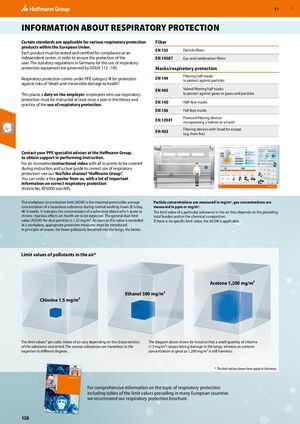
ИНФОРМАЦИЯ О ЗАЩИТЕ ОРГАНОВ ДЫХАНИЯ
Для различных продуктов для защиты органов дыхания в Европейском союзе действуют определенные стандарты. Каждый продукт должен быть протестирован и сертифицирован на соответствие в независимом центре, чтобы обеспечить защиту пользователя. Законодательные требования в Германии к использованию оборудования для защиты органов дыхания определяются стандартом DGUV 112–190.
Защита органов дыхания входит в категорию III средств индивидуальной защиты для защиты от рисков "смерти и необратимого ущерба здоровью". Это возлагает обязательства на работодателя; работники, использующие защиту органов дыхания, должны получать инструктаж не менее одного раза в год по теории и практике использования защиты органов дыхания.
Применимые стандарты
| Тип фильтра/маски | Стандарт | Описание |
|---|---|---|
| Фильтры | EN 143 | Частичные фильтры |
| EN 14387 | Газовые и комбинированные фильтры | |
| Маски/оборудование для защиты органов дыхания | EN 149 | Фильтрующие полумаски для защиты от частиц |
| EN 405 | Клапанные фильтрующие полумаски для защиты от газов или газов и частиц | |
| EN 140 | Полумаски | |
| EN 136 | Полнолицевые маски | |
| Системы дыхания с подачей воздуха | EN 12941 | Системы с капюшоном или шлемом |
| EN 403 | Системы с капюшоном для эвакуации (например, при пожаре) |
Обратитесь к специалисту по средствам индивидуальной защиты компании для получения помощи в проведении обучения.
Для инновационного обучающего видео со всеми пунктами, которые должны быть охвачены во время обучения, и четкого руководства по правильному использованию защиты органов дыхания, см. наш канал YouTube "Hoffmann Group".
Вы можете заказать у нас бесплатный плакат с информацией о правильной защите органов дыхания (артикул KP3000, размер AIR).
Предельные значения загрязняющих веществ в воздухе
Предельная концентрация рабочего места (AGW) — это максимальная допустимая средняя концентрация опасного вещества во время нормального рабочего времени (8 часов/день, 40 часов/неделю). Она указывает концентрацию вещества, выше которой ожидаются острые или хронические неблагоприятные воздействия на здоровье. Общее предельное значение для пыли (AGSW) составляет 1,25 мг/м³. Как только это значение превышается на рабочем месте, должны быть введены надлежащие защитные меры.
В принципе, конечно: чем меньше загрязняющих веществ вдыхается в легкие, тем лучше.
Концентрации частиц измеряются в мг/м³, концентрации газов — в ppm или мг/м³. Предельное значение конкретного вещества в воздухе зависит от преобладающего общего бремени и химического состава. Если нет конкретного предельного значения, применяется AGSW.
Пример пределов: Хлор 1,5 мг/м³; Этанол 380 мг/м³; Ацетон 1200 мг/м³
Диаграмма выше показывает, например, что небольшое количество хлора (1,5 мг/м³) вызывает стойкое повреждение легких, тогда как концентрация ацетона 1200 мг/м³ все еще безвредна.
Указанные здесь предельные значения применяются к Германии.
Для получения подробной информации по теме защиты органов дыхания, включая таблицы предельных значений, действующих во многих европейских странах, рекомендуем наш справочник по защите органов дыхания.